AirSnitch Targets Wi-Fi Through Cross-Layer Identity Desynchronization
THE BRIEF
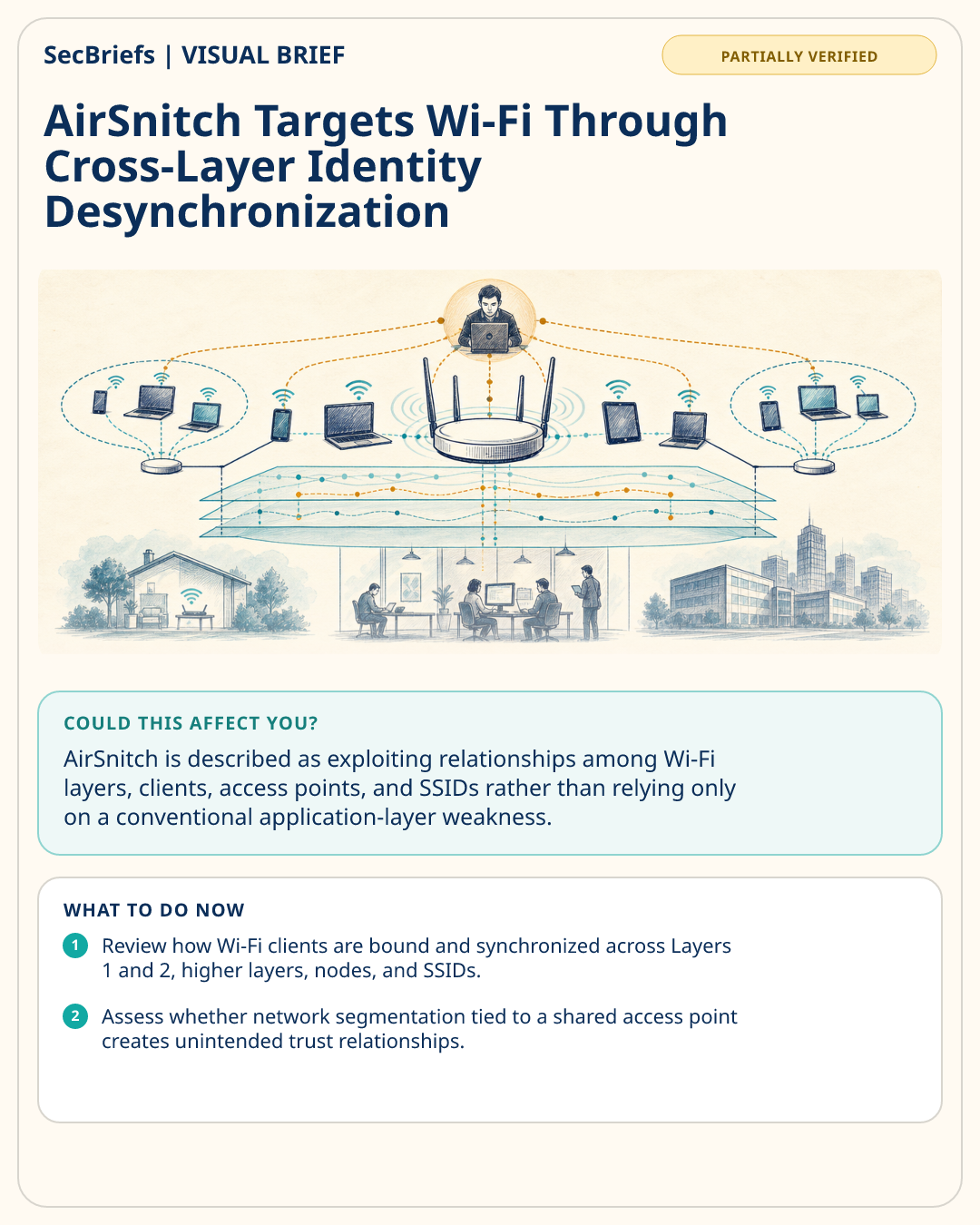
Schneier on Security described AirSnitch as a Wi-Fi attack that exploits core features in Layers 1 and 2 and a failure to bind and synchronize a client across those layers, higher layers, other nodes, and different network names, including SSIDs. The account identifies this cross-layer identity desynchronization as the attack’s key driver. Its most powerful form is described as a full, bidirectional machine-in-the-middle attack, allowing an attacker to view and modify data before it reaches the intended recipient. The attacker may be on the same SSID, a separate SSID, or a separate network segment connected to the same access point. The described technique applies to small Wi-Fi networks in homes and offices as well as large enterprise networks. Because it can intercept link-layer traffic as that traffic passes between Layers 1 and 2, the attack can support additional attacks, although the supplied excerpt does not specify them. The report therefore presents AirSnitch as a cross-layer Wi-Fi issue spanning different network sizes and placements.
WHY IT MATTERS
AirSnitch is described as exploiting relationships among Wi-Fi layers, clients, access points, and SSIDs rather than relying only on a conventional application-layer weakness. The supplied account says an attacker could potentially view and modify traffic, and could operate from several network positions, including a separate segment tied to the same access point. That combination makes the issue relevant to homes, offices, and enterprises. The excerpt does not provide affected products, mitigations, or exploitation results, so those details remain open.
WHO SHOULD CARE
Wi-Fi equipment makers, network administrators, enterprise security teams, office and home network operators, and defenders responsible for traffic integrity should care. Researchers and assessors should also examine how clients are bound across layers, SSIDs, nodes, and network segments.
WHAT TO DO NOW
- Review how Wi-Fi clients are bound and synchronized across Layers 1 and 2, higher layers, nodes, and SSIDs.
- Assess whether network segmentation tied to a shared access point creates unintended trust relationships.
- Monitor for unexpected link-layer traffic conditions and traffic modification indicators.
- Obtain product-specific technical guidance before drawing conclusions about exposure or remediation.