Anthropic loses Pentagon role as OpenAI moves in
THE BRIEF
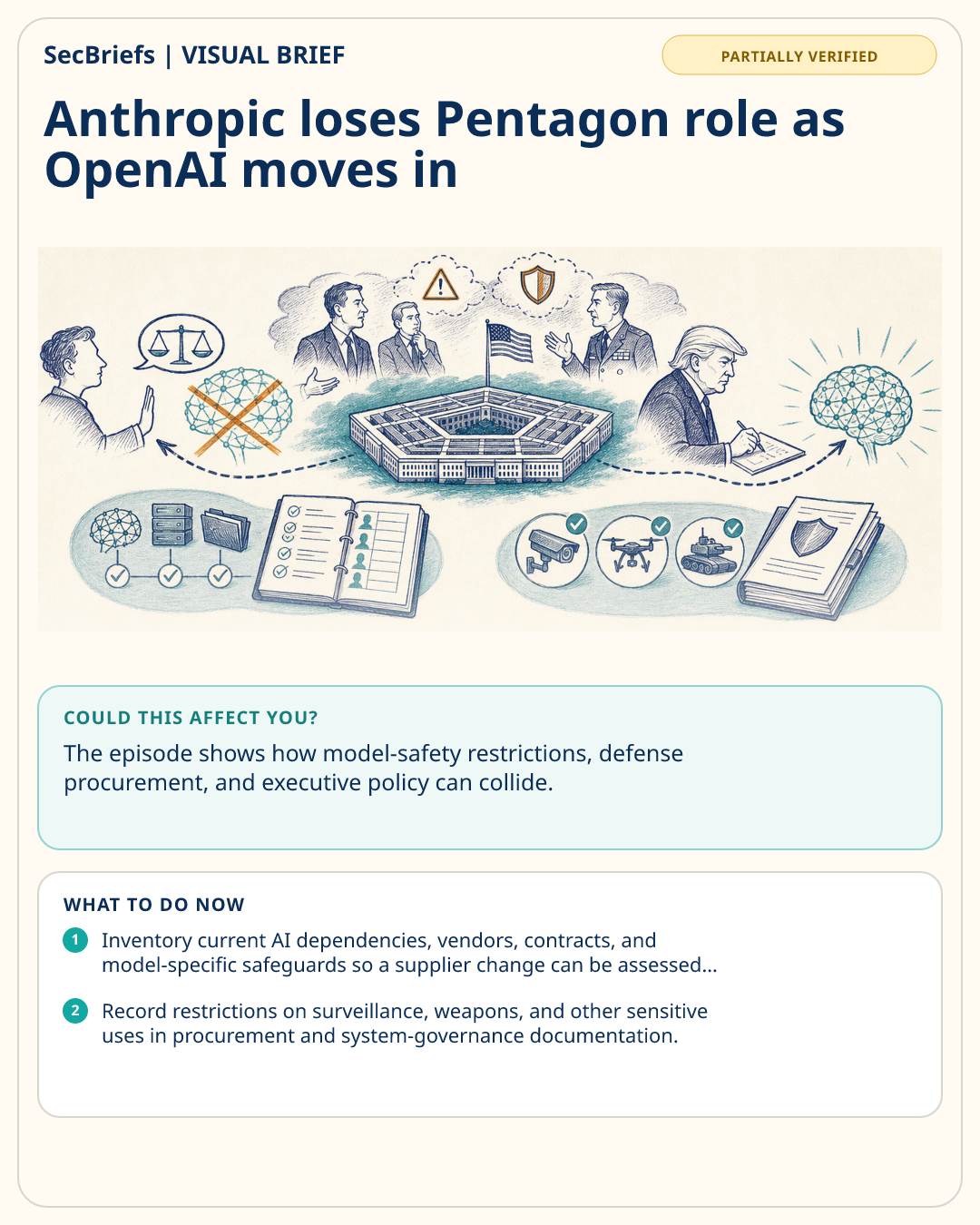
Schneier on Security reports that OpenAI is in and Anthropic is out as a supplier of artificial-intelligence technology for the US Department of Defense. The account follows a week of public confrontation between senior US government officials and major technology executives, against a backdrop of debate about the existential risks of powerful AI systems and the Pentagon’s claim that the technology is essential to national security. The dispute centered on Anthropic’s insistence that the Department of Defense could not use its models to facilitate mass surveillance or fully autonomous weapons. Defense Secretary Pete Hegseth derided those provisions as “woke,” according to the supplied excerpt. The conflict culminated on Friday evening when Donald Trump issued an order for federal agencies to discontinue use of Anthropic models. Within hours, OpenAI had moved in, potentially positioning itself for hundreds of millions of dollars in government contracts through an agreement whose details are cut off in the supplied excerpt. The report does not provide the final contract terms, implementation status, or operational results.
WHY IT MATTERS
The episode shows how model-safety restrictions, defense procurement, and executive policy can collide. Anthropic’s stated limits concerned mass surveillance and fully autonomous weapons, while the Pentagon characterized its technology as essential to national security. The supplied account says OpenAI moved in after an order ending federal use of Anthropic models, but it does not provide the agreement’s full terms or confirm outcomes. That uncertainty matters for agencies assessing vendor continuity, governance controls, and the consequences of changing AI suppliers under political pressure.
WHO SHOULD CARE
Defense and civilian agencies using AI, procurement officials, model providers, civil-liberties advocates, and security leaders should care. Organizations should also follow how contract changes affect safeguards, authorized uses, and continuity of government technology programs.
WHAT TO DO NOW
- Inventory current AI dependencies, vendors, contracts, and model-specific safeguards so a supplier change can be assessed quickly.
- Record restrictions on surveillance, weapons, and other sensitive uses in procurement and system-governance documentation.
- Evaluate whether replacement models preserve existing security, privacy, safety, audit, and human-oversight controls.
- Prepare continuity plans for government or regulated workflows that depend on a particular model provider or contract.