Malicious Axios releases put developer systems and credentials at risk
THE BRIEF
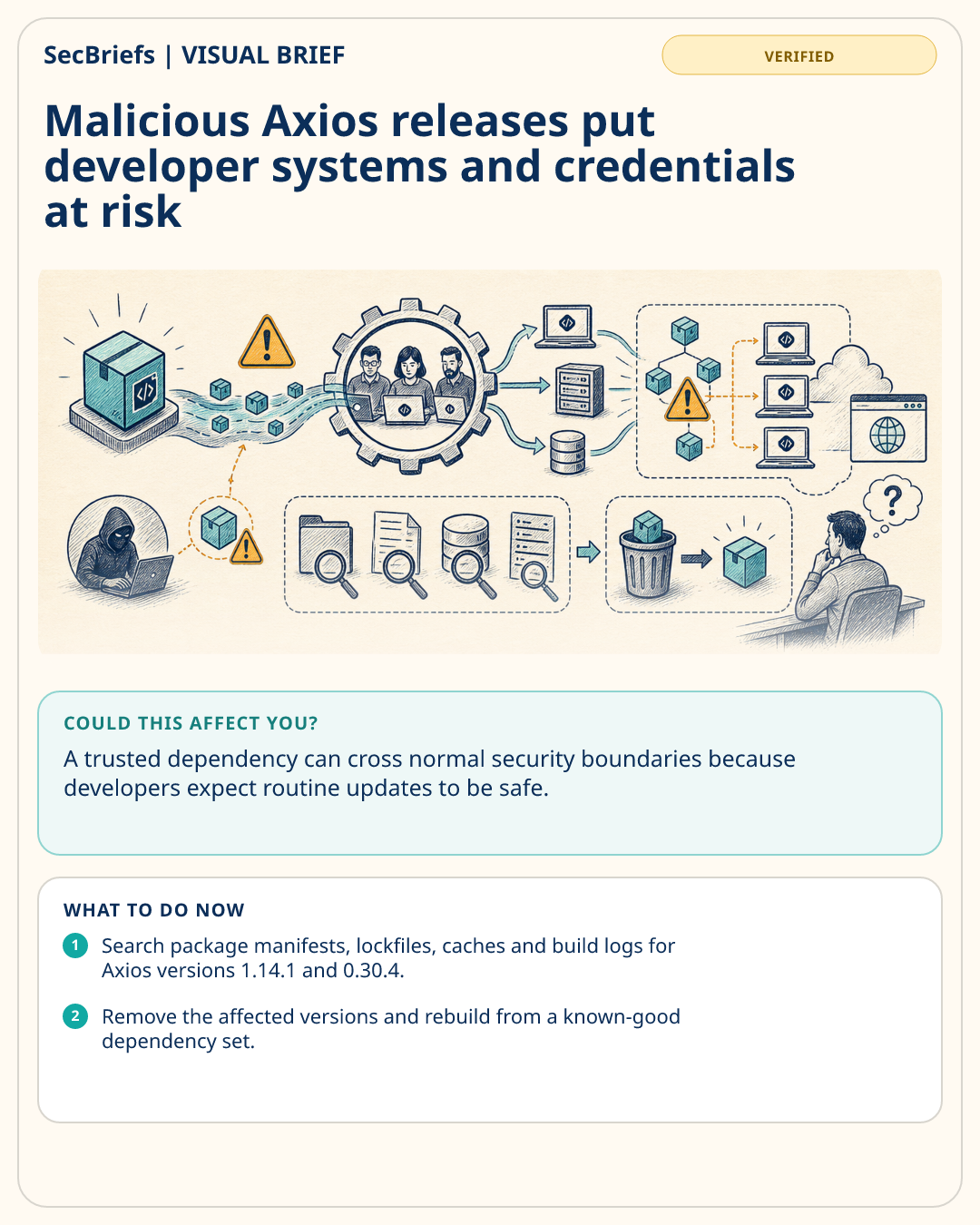
Google Threat Intelligence said malicious dependencies appeared in Axios versions 1.14.1 and 0.30.4 during a roughly three-hour window. Its researchers linked the activity to UNC1069, a financially motivated North Korea-linked group, based on malware and infrastructure overlaps. CyberScoop reported the incident as a supply-chain compromise, meaning attackers abused software that other teams rely on rather than attacking every victim directly. The affected releases were removed, but deletion from the public registry does not remove copies already downloaded into developer laptops, build servers or cached repositories. The total number of affected systems remained uncertain at publication. Organizations therefore needed to check what they installed, not assume the short exposure window made them safe. This was primarily a risk to software teams and businesses running JavaScript build pipelines. It could become a wider customer issue if stolen credentials or persistent access were later used against production services.
WHY IT MATTERS
A trusted dependency can cross normal security boundaries because developers expect routine updates to be safe. If a compromised package reaches a build system, attackers may gain credentials, source code or access that can be reused against customer-facing services. The practical lesson is broader than Axios: organizations need an inventory of third-party components, controlled update processes and the ability to identify exactly where a version was installed. A three-hour malicious release can create weeks of investigation when caches, laptops and automated pipelines are involved, so rapid version checks and credential rotation matter.
WHO SHOULD CARE
Software developers, engineering managers, security teams and organizations that build or deploy JavaScript applications should care. Customers are indirectly exposed when compromised development environments hold production credentials, signing keys or access to services that process their information.
WHAT TO DO NOW
- Search package manifests, lockfiles, caches and build logs for Axios versions 1.14.1 and 0.30.4.
- Remove the affected versions and rebuild from a known-good dependency set.
- Rotate credentials or tokens exposed to systems that installed the malicious releases.
- Review developer endpoints and build servers for the indicators published by Google Threat Intelligence.
- Require protected publishing, short-lived tokens and dependency approval controls for critical packages.