Dutch Finance Ministry breach disrupted employees but spared public services
THE BRIEF
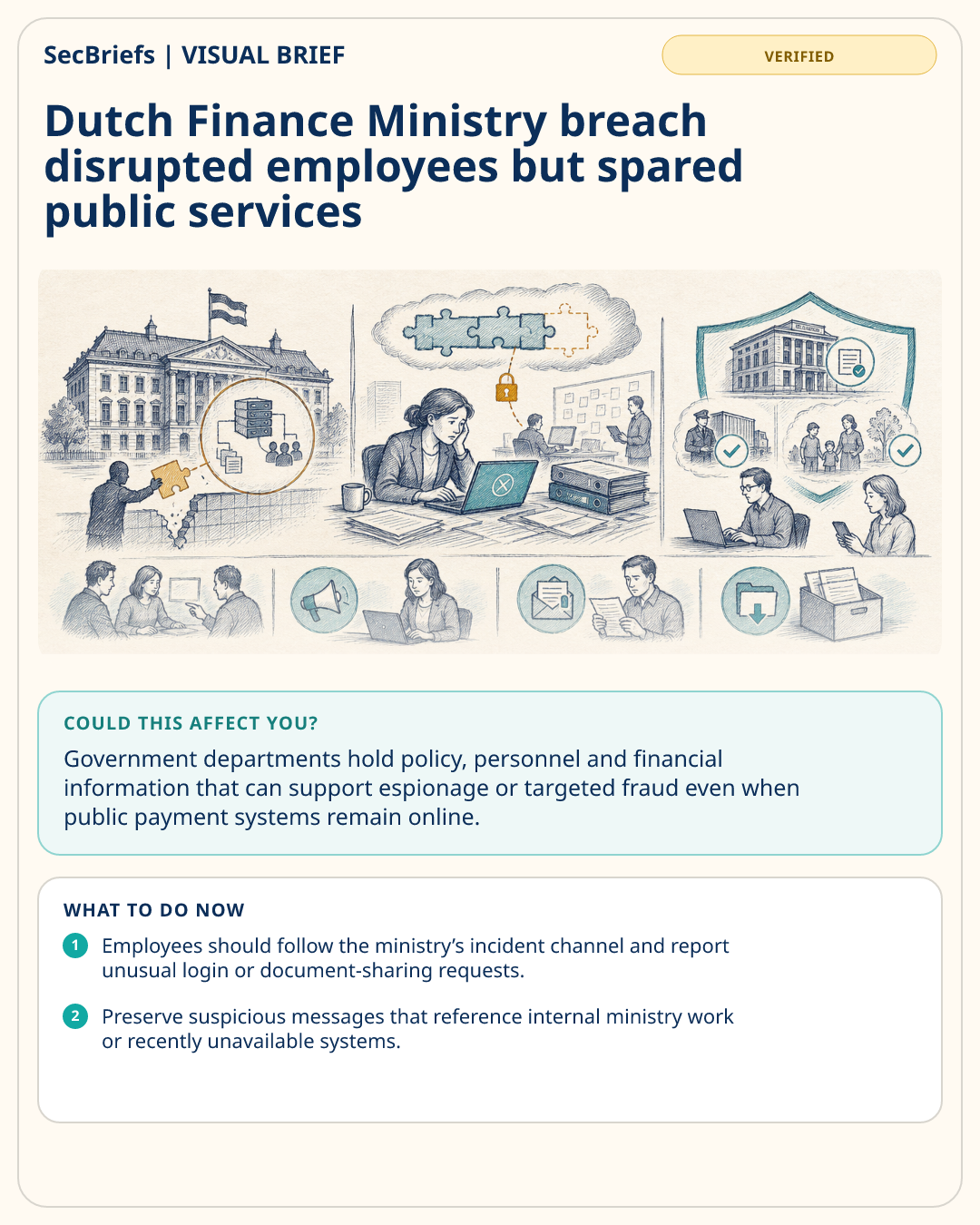
The incident disrupted work for some ministry employees. Officials said public services run by the Tax Administration, Customs and the Benefits Agency were not affected. That distinction is important because the ministry’s internal environment and citizen-facing financial services do not share one simple operational boundary. At publication, the ministry had not disclosed who was responsible, how access was obtained or whether information had been removed. BleepingComputer reported the event after the government’s disclosure. Later operational measures included taking parts of the environment offline, but public reporting did not establish a complete list of affected systems or people. Employees should assume that incident communications may change as forensic work progresses. Citizens and businesses, meanwhile, should avoid interpreting the breach as proof that tax or benefits accounts were compromised. The confirmed consequence was restricted internal access and employee disruption, with the wider data impact still uncertain.
WHY IT MATTERS
Government departments hold policy, personnel and financial information that can support espionage or targeted fraud even when public payment systems remain online. Separating confirmed internal impact from unaffected citizen services helps prevent unnecessary alarm while preserving attention on employee risk. For public-sector managers, the incident underlines the value of segmented systems, independent detection and continuity plans for staff who lose access to primary tools. For individuals, official notifications matter more than speculation: a ministry breach does not automatically mean every taxpayer or benefits recipient needs to reset credentials.
WHO SHOULD CARE
Dutch Finance Ministry employees and public-sector security teams are the primary audience because internal systems and work processes were affected. Taxpayers, customs users and benefits recipients should care mainly to distinguish confirmed service continuity from unverified claims about broader data exposure.
WHAT TO DO NOW
- Employees should follow the ministry’s incident channel and report unusual login or document-sharing requests.
- Preserve suspicious messages that reference internal ministry work or recently unavailable systems.
- Do not infer a tax or benefits account breach without an official notice tied to those services.
- Public-sector teams should verify segmentation between policy systems and citizen-facing platforms.