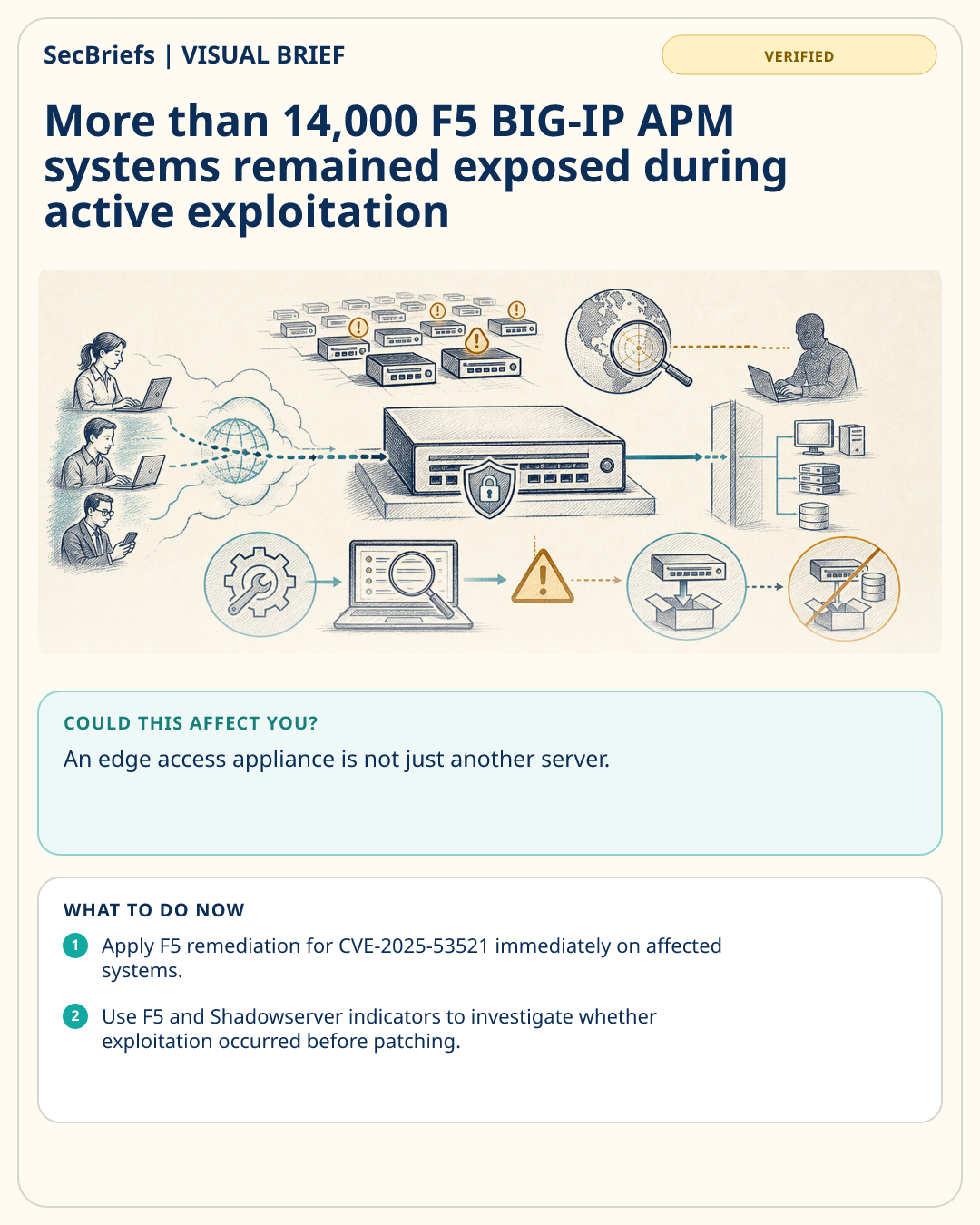
More than 14,000 F5 BIG-IP APM systems remained exposed during active exploitation
THE BRIEF
Shadowserver reported more than 14,000 internet-exposed F5 BIG-IP Access Policy Manager systems that appeared exposed to attacks involving CVE-2025-53521. The vulnerability had originally been disclosed as a denial-of-service issue but F5 reclassified it as remote code execution after receiving new information and confirmed that exploitation had occurred in vulnerable versions. Attackers without privileges could exploit affected BIG-IP APM systems when access policies were configured on a virtual server. CISA added the flaw to its catalog of known exploited vulnerabilities and ordered U.S. federal agencies to remediate it. F5 published indicators of compromise and warned that organizations finding evidence of intrusion may need to rebuild affected systems from a known-good source, because backups created after compromise could preserve malicious changes. BIG-IP devices frequently sit at a sensitive boundary between external users and internal applications, making successful exploitation particularly consequential for enterprise access.
WHY IT MATTERS
An edge access appliance is not just another server. It often terminates authentication, proxies traffic and has visibility into internal services. Remote code execution on that boundary can therefore give attackers a strategically useful position before they ever reach an application server. The scale of internet exposure also demonstrates a familiar operational gap: vendors can release fixes and agencies can issue urgent directives, yet thousands of systems may remain reachable. Patch status and compromise assessment must be treated as separate tasks, because updating a device after exploitation does not remove persistence that may already exist.
WHO SHOULD CARE
Network-security teams, F5 administrators, CISOs, organizations exposing BIG-IP APM to the internet and incident-response teams should prioritize this issue. Application owners relying on BIG-IP for remote access should also be included.
WHAT TO DO NOW
- Apply F5 remediation for CVE-2025-53521 immediately on affected systems.
- Use F5 and Shadowserver indicators to investigate whether exploitation occurred before patching.
- Rebuild from a known-good configuration if compromise cannot be confidently excluded.
- Reduce unnecessary internet exposure and inventory every externally reachable access appliance.
VERIFICATION NOTE
Historical backfill verified against the cited BleepingComputer report, F5 advisory updates, Shadowserver data and CISA action.