Hacked Prayer-Timing App Delivered Messages During Explosions in Iran
THE BRIEF
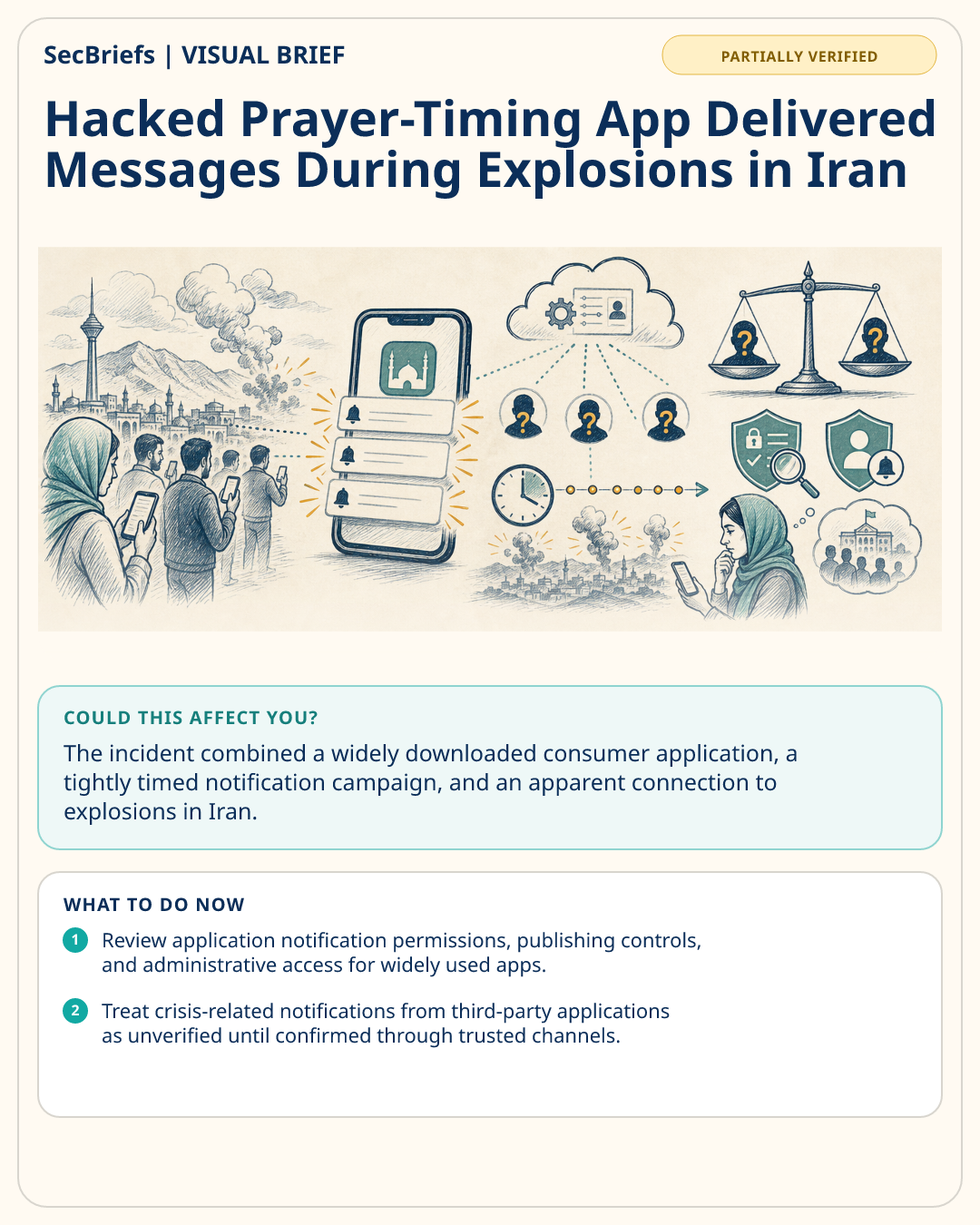
According to Schneier on Security, an apparently hacked prayer-timing app called BadeSaba Calendar sent Iranian users bursts of phone notifications shortly after a first set of explosions. The app had been downloaded more than 5 million times from the Google Play Store. The messages arrived over roughly 30 minutes, beginning at 9:52 a.m. Tehran time with the phrase “Help has arrived.” The notifications did not come from the government as a caution advisory, but through the app. No party claimed responsibility for the hack. Schneier’s account says the speed of the operation made a government operation seem likely, while also presenting the possibility that the United States or Israel had previously obtained access and chose to use it at that moment. Those possibilities remain presented as speculation, not attribution. The incident illustrates how access to a widely downloaded application could potentially be used to deliver a message during a fast-moving crisis, while leaving users and observers to distinguish verified facts from competing explanations.
WHY IT MATTERS
The incident combined a widely downloaded consumer application, a tightly timed notification campaign, and an apparent connection to explosions in Iran. The available account does not establish who compromised BadeSaba Calendar or whether the United States, Israel, or another party was responsible. That uncertainty matters: the messages were visible to users as an application notification, but the purpose, access method, and broader effects are not established in the supplied facts. For defenders, the episode highlights the security and trust implications of application-based communications during crises.
WHO SHOULD CARE
Mobile-app developers, app-store security teams, Iranian users of BadeSaba Calendar, incident responders, and officials responsible for crisis communications should care. Analysts examining possible state operations should separate the reported notification timeline from unconfirmed attribution.
WHAT TO DO NOW
- Review application notification permissions, publishing controls, and administrative access for widely used apps.
- Treat crisis-related notifications from third-party applications as unverified until confirmed through trusted channels.
- Preserve notification timing and app telemetry so investigators can examine the reported 30-minute sequence.
- Avoid attributing the activity to a government or named country without supporting evidence.