
Kimwolf Botnet Reportedly Reaches More Than 2 Million Devices
THE BRIEF
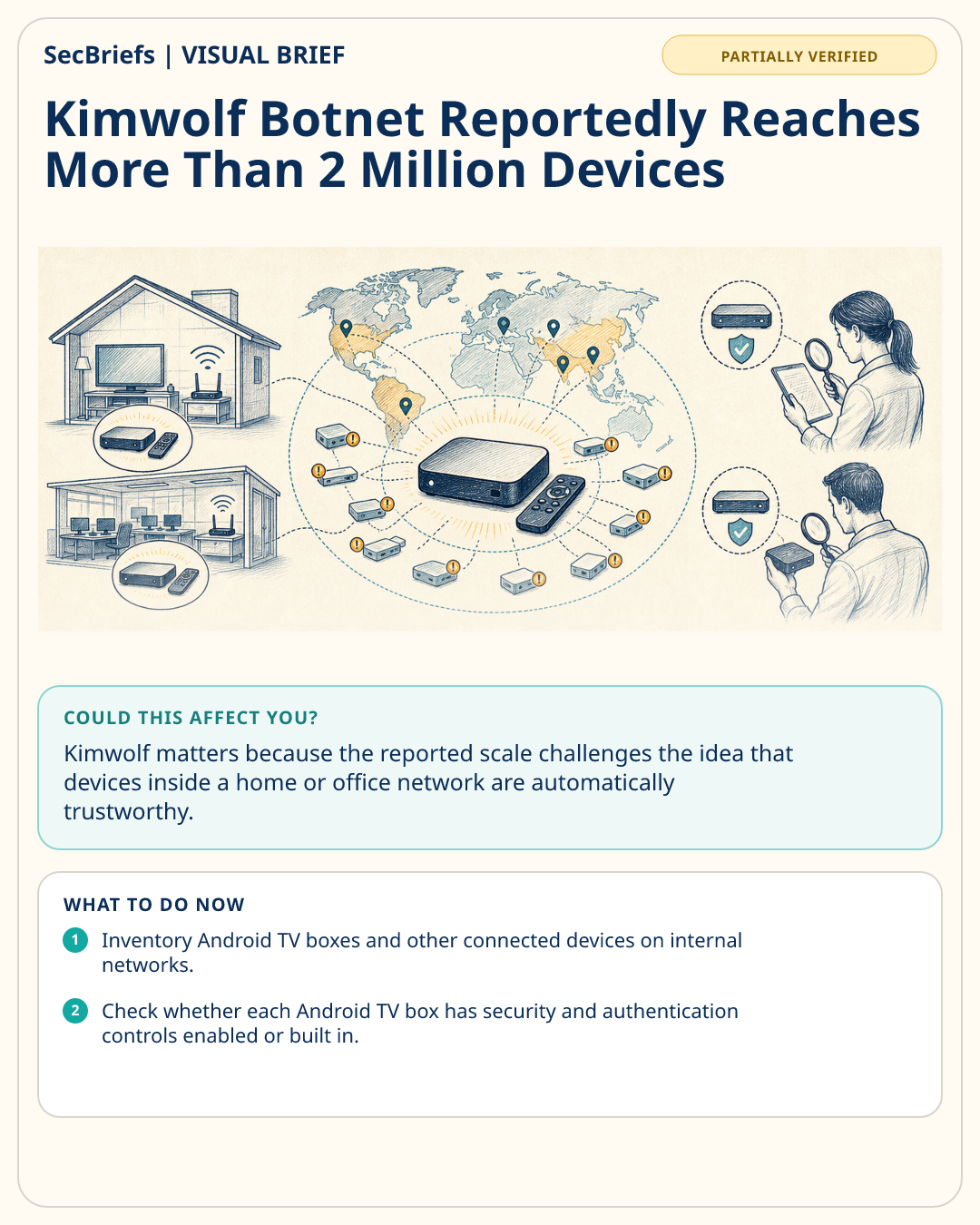
Krebs on Security reports that a botnet dubbed Kimwolf has grown rapidly and is affecting devices connected to internal networks. The report says security company Synthient currently sees more than 2 million infected Kimwolf devices worldwide, with concentrations in Vietnam, Brazil, India, Saudi Arabia, Russia, and the United States. Synthient reportedly found that two-thirds of the infections involve Android TV boxes, many of which have no security or authentication built in. The report frames the activity as part of a broader Internet-wide security advisory, saying the vulnerability involved has been exploited for months. It argues that assumptions about the safety of the network behind an Internet router may now be dangerously out of date. The supplied excerpt does not identify the vulnerability, explain how Kimwolf spreads, or provide a confirmed victim list. These details are reported by Krebs on Security and attributed in part to Synthient, so the figures and characterization should be treated as reported findings rather than independently verified facts.
WHY IT MATTERS
Kimwolf matters because the reported scale challenges the idea that devices inside a home or office network are automatically trustworthy. If Synthient’s estimate is accurate, more than 2 million devices are involved, and Android TV boxes make up a large share. The report also says the vulnerability has been exploited for months, suggesting the issue is not merely theoretical. Organizations should treat unmanaged or weakly protected connected devices as a point requiring review, while remembering that the excerpt does not establish the botnet’s full capabilities, affected products, or confirmed impact.
WHO SHOULD CARE
Network defenders, IT administrators, security leaders, and households or businesses using Android TV boxes should review whether these devices are present and whether internal-network assumptions still hold.
WHAT TO DO NOW
- Inventory Android TV boxes and other connected devices on internal networks.
- Check whether each Android TV box has security and authentication controls enabled or built in.
- Review network segmentation and access controls for devices that cannot provide those controls.
- Track guidance about the reported vulnerability and document whether internal devices may be affected.
VERIFICATION NOTE
Reported by Krebs on Security; this archive brief does not add independent confirmation beyond the cited source.