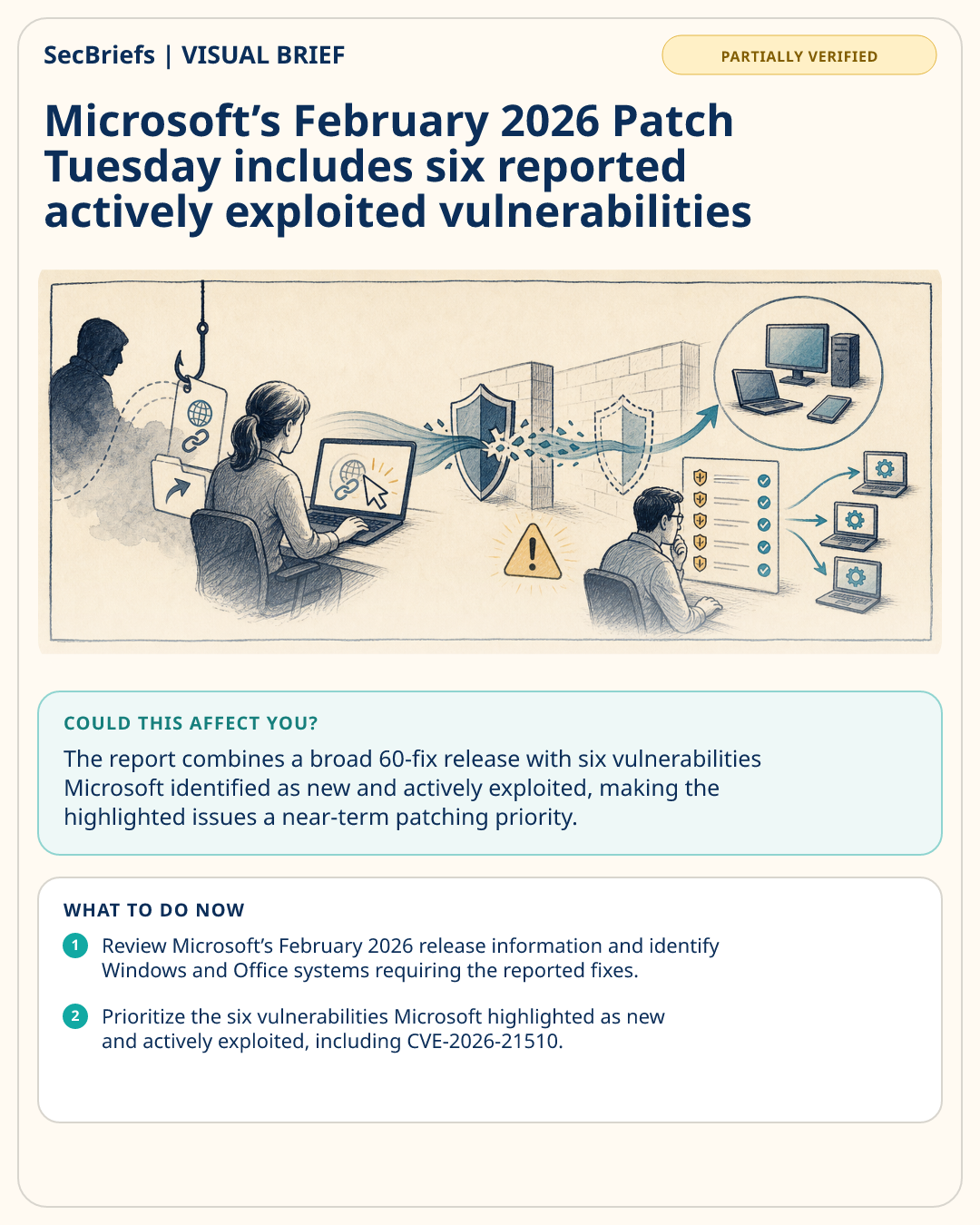
Microsoft’s February 2026 Patch Tuesday includes six reported actively exploited vulnerabilities
THE BRIEF
CSO Online reports that Microsoft’s February 2026 Patch Tuesday release addressed 60 vulnerabilities, including six that Microsoft highlighted as new and actively exploited. The report says three of those six involve security-feature bypasses. One example, CVE-2026-21510, is described as a Windows Shell protection-mechanism failure that allows an unauthorized attacker to bypass a security feature over a network. Successful exploitation requires convincing a user to open a malicious link or shortcut file. The report says attackers could then bypass Windows SmartScreen and Windows Shell security prompts by exploiting improper handling in Windows Shell components. Tyler Reguly, associate director of security R&D at Fortra, says the issues are easy to resolve with regular Microsoft patches for Windows and Office, and none require post-patch configuration steps. This makes prompt patching the report’s central operational takeaway. Organizations should assess exposure, prioritize the highlighted fixes, and confirm deployment across relevant endpoints.
WHY IT MATTERS
The report combines a broad 60-fix release with six vulnerabilities Microsoft identified as new and actively exploited, making the highlighted issues a near-term patching priority. CVE-2026-21510 is especially relevant to user-driven attack paths: exploitation depends on persuading someone to open a malicious link or shortcut, after which Windows Shell security protections could be bypassed. The reported absence of post-patch configuration steps may simplify remediation, but teams still need to verify that regular Windows and Office patches reach the systems they manage.
WHO SHOULD CARE
Security leaders, Windows and Office administrators, vulnerability-management teams, and help-desk or user-awareness teams should care. The reported issues combine patching needs with a malicious-link or shortcut-file condition involving Windows Shell.
WHAT TO DO NOW
- Review Microsoft’s February 2026 release information and identify Windows and Office systems requiring the reported fixes.
- Prioritize the six vulnerabilities Microsoft highlighted as new and actively exploited, including CVE-2026-21510.
- Deploy the regular Microsoft patches and verify successful installation across relevant endpoints.
- Remind users not to open untrusted links or shortcut files, given the reported exploitation condition involving Windows Shell.