Opus 4.6 Shows Faster, Stronger Vulnerability Finding in Early Tests
THE BRIEF
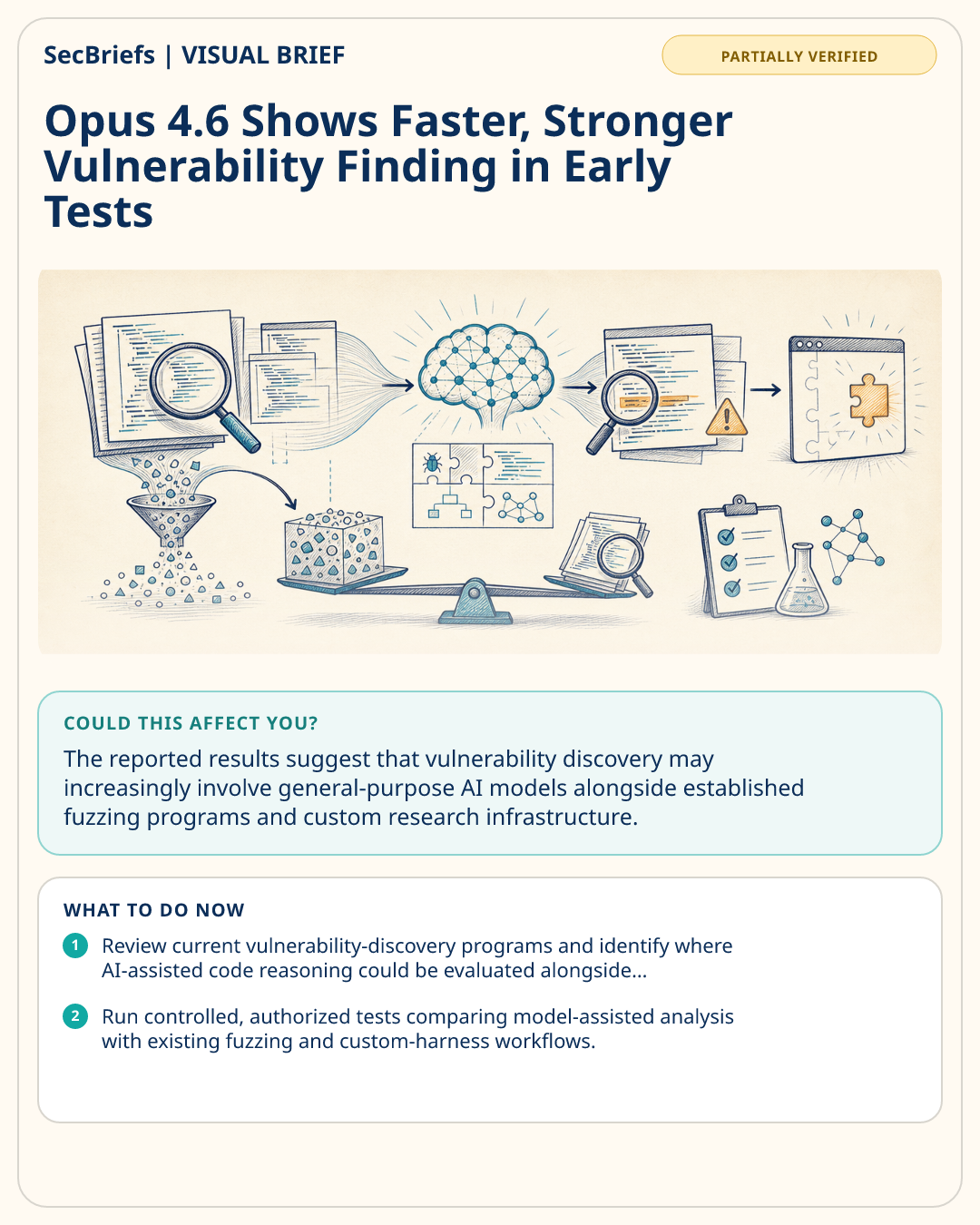
Schneier on Security reports that Anthropic’s Opus 4.6 is notably better at finding high-severity vulnerabilities than previous models, based on early testing. The report says the model found vulnerabilities quickly and without task-specific tools, custom scaffolding, or specialized prompting. That contrasts with traditional fuzzing, which uses large volumes of random inputs to identify what breaks in code. According to the account, Opus 4.6 reads and reasons about code more like a human researcher: it can examine past fixes for similar bugs that may not have been addressed, recognize patterns associated with problems, and understand logic well enough to identify an input that could break it. The headline also describes the model as improving at exploiting zero-days, although the supplied excerpt provides no additional details about those tests. Schneier on Security presents the development as evidence that AI-assisted vulnerability discovery is moving quickly, particularly when capability appears out of the box rather than after specialized infrastructure is built around the model.
WHY IT MATTERS
The reported results suggest that vulnerability discovery may increasingly involve general-purpose AI models alongside established fuzzing programs and custom research infrastructure. The notable point is not only that Opus 4.6 reportedly performed well, but that it did so without specialized tooling or prompting in the early testing described. Security organizations may therefore need to understand how model-assisted code analysis compares with their existing processes. The supplied account does not establish the breadth, reliability, or operational impact of the findings, so the results should be treated as an important signal rather than a complete measure of real-world capability.
WHO SHOULD CARE
Application security teams, vulnerability researchers, software developers, security leaders, and organizations investing in fuzzing or code-analysis infrastructure should follow these reported improvements and consider how AI-assisted discovery fits their existing work.
WHAT TO DO NOW
- Review current vulnerability-discovery programs and identify where AI-assisted code reasoning could be evaluated alongside fuzzing.
- Run controlled, authorized tests comparing model-assisted analysis with existing fuzzing and custom-harness workflows.
- Document findings carefully, including whether results depend on past fixes, recognizable code patterns, or specific inputs.