Palo Alto Networks Reports New Group Compromised 70 Organizations in 37 Countries
THE BRIEF
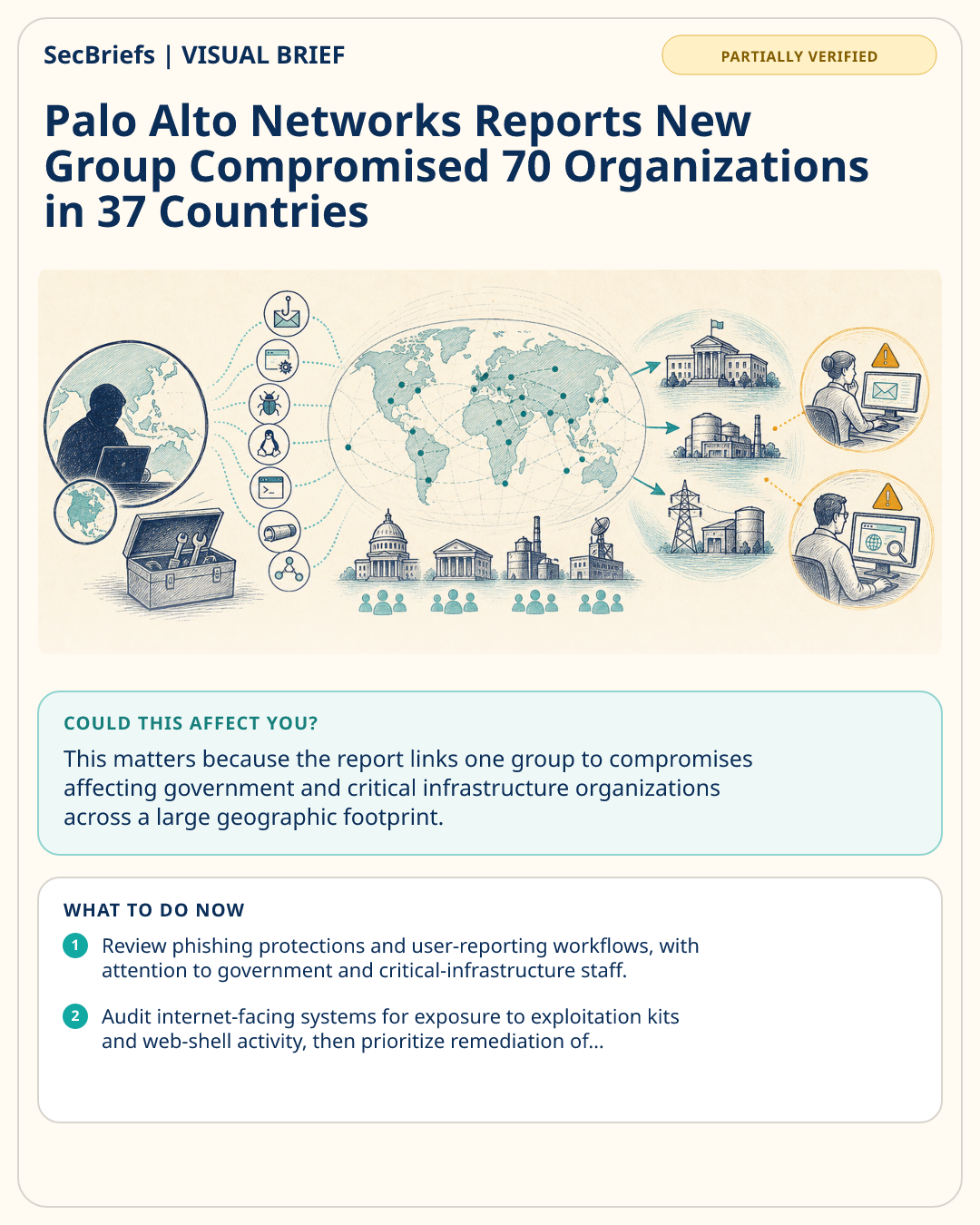
Security researchers at Palo Alto Networks report that a newly identified cyberespionage group, tracked as TGR-STA-1030 and also called UNC6619, compromised 70 government and critical infrastructure organizations in 37 countries during the past year. According to the report, the group used phishing, exploitation kits, custom malware, Linux rootkits, web shells, tunneling tools, and proxy tools. Researchers say the activity appears to be expanding: between November and December 2025, they observed active reconnaissance against government infrastructure associated with 155 countries. Palo Alto Networks believes the group operates from Asia, citing language settings, regional tooling preferences, GMT+8 working hours, and targeting aligned with events; the supplied excerpt does not provide further detail on those events. The reported combination spans initial access, post-compromise tooling, and traffic-routing capabilities, although the excerpt does not provide further operational detail. The findings also indicate that reconnaissance may be broader than the organizations already compromised, but the scale of any future activity is not established.
WHY IT MATTERS
This matters because the report links one group to compromises affecting government and critical infrastructure organizations across a large geographic footprint. The reported use of multiple access and post-compromise techniques—including phishing, exploitation kits, malware, rootkits, web shells, tunneling, and proxies—suggests defenders may need visibility across several control points rather than a single detection layer. The reconnaissance associated with 155 countries also indicates that organizations not listed among the 70 reported compromises may still warrant attention, although the supplied account does not establish that they were targeted successfully.
WHO SHOULD CARE
Government security teams, critical infrastructure operators, national cyber authorities, and organizations responsible for Linux, web-facing systems, email security, and network monitoring should care. Security leaders may also use the report to review exposure across geographically dispersed environments.
WHAT TO DO NOW
- Review phishing protections and user-reporting workflows, with attention to government and critical-infrastructure staff.
- Audit internet-facing systems for exposure to exploitation kits and web-shell activity, then prioritize remediation of identified weaknesses.
- Hunt for unexpected Linux rootkits, custom malware, tunneling, and proxy tooling across monitored environments.