Phishing emails impersonate Afghanistan’s prime minister’s office in targeting of government workers
THE BRIEF
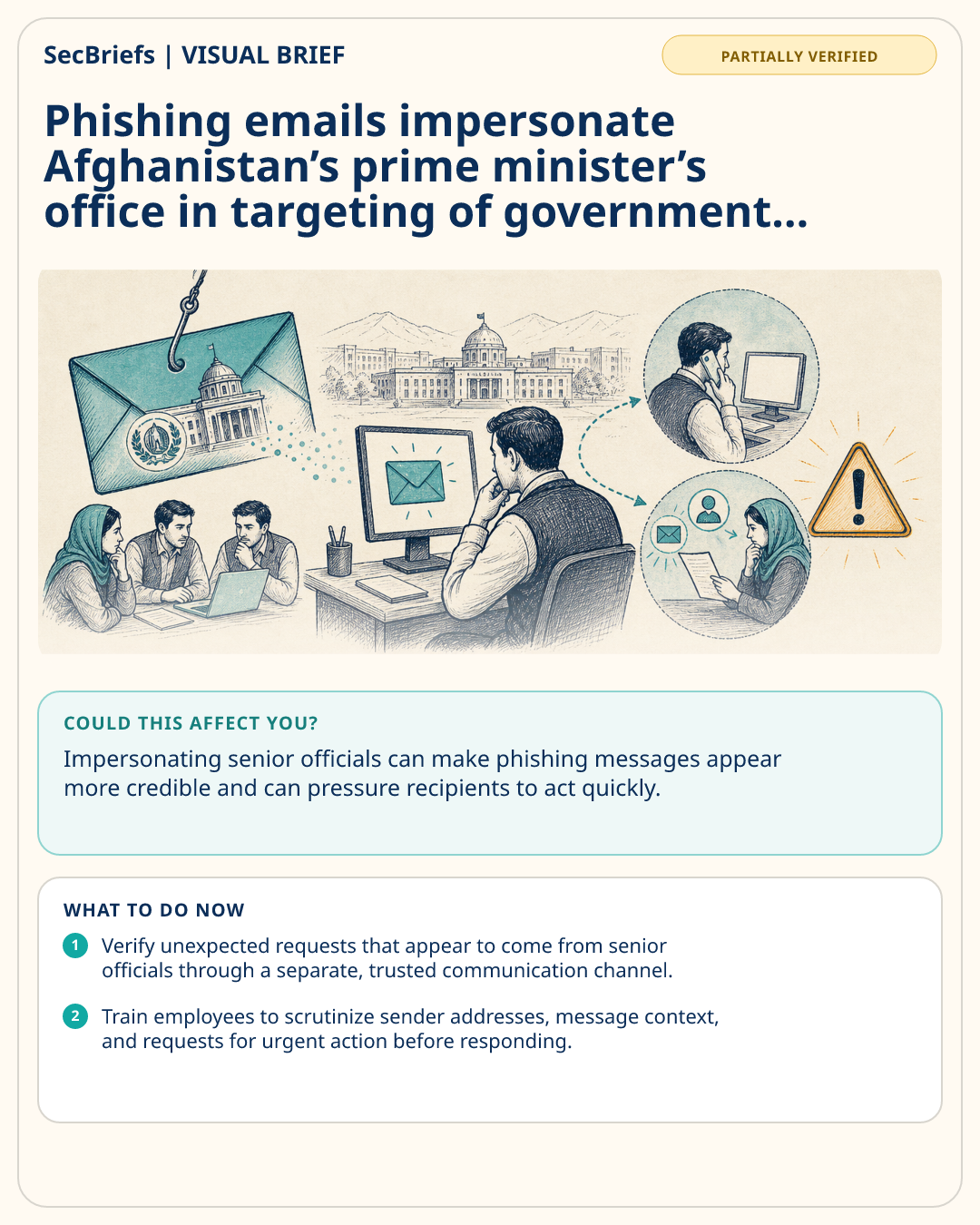
Researchers reported that hackers are targeting Afghan government employees with phishing emails made to look like official correspondence from the office of Afghanistan’s prime minister. The account, published by The Record from Recorded Future News on Jan. 20, 2026, identifies the apparent tactic but does not provide further details in the supplied report about the messages, their contents, the people behind the campaign, or whether any recipients opened links, shared information, or suffered compromise. The central warning is impersonation: a familiar government authority is being used as the apparent cover for malicious email. Organizations whose staff handle government correspondence can use this report as a prompt to reinforce scrutiny of unexpected messages, particularly those invoking senior officials. Because the available information is limited, readers should treat the activity as reported rather than as a fully verified assessment of scope or impact.
WHY IT MATTERS
Impersonating senior officials can make phishing messages appear more credible and can pressure recipients to act quickly. This report is relevant because it identifies Afghan government workers as the target group and the prime minister’s office as the apparent disguise. The supplied information does not establish how many messages were sent, whether anyone was affected, or what the attackers sought. Even so, the example highlights why email trust decisions should rely on independent verification, not authority cues alone.
WHO SHOULD CARE
Afghan government agencies and employees should care first, especially teams that exchange sensitive correspondence by email. Security leaders, IT administrators, and public-sector partners can also use the report to review controls for impersonation and suspicious messages.
WHAT TO DO NOW
- Verify unexpected requests that appear to come from senior officials through a separate, trusted communication channel.
- Train employees to scrutinize sender addresses, message context, and requests for urgent action before responding.
- Route suspicious government-themed correspondence to security or IT teams for review instead of forwarding or acting on it.
- Review email protections and reporting procedures for impersonation and phishing attempts.
VERIFICATION NOTE
Reported by The Record from Recorded Future News; this archive brief does not add independent confirmation beyond the cited source.