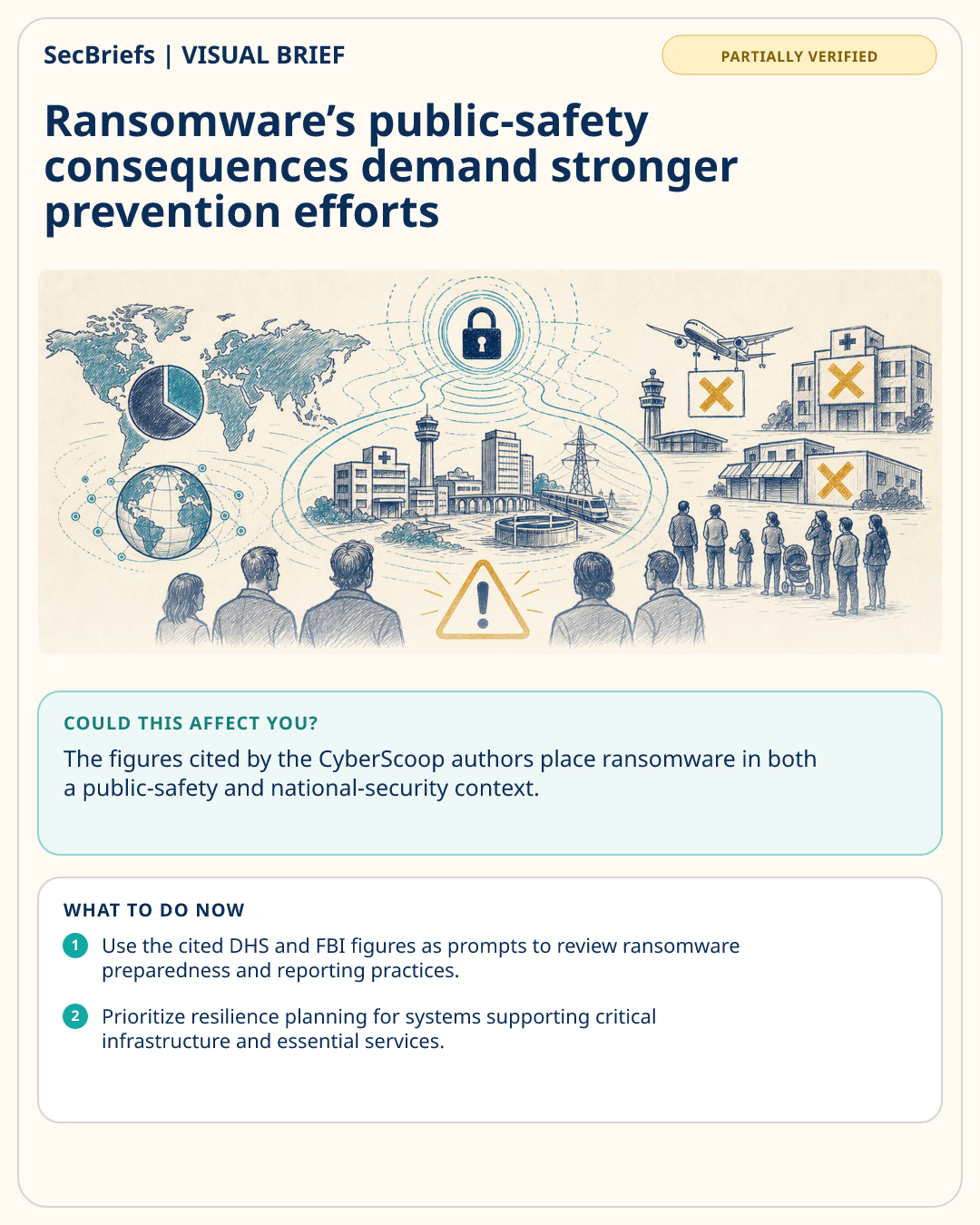
Ransomware’s public-safety consequences demand stronger prevention efforts
THE BRIEF
In a CyberScoop opinion article, former leaders of FBI and CISA cyber units argue that ransomware and similar cyberattacks have become routine despite consequences that can include canceled flights, closed emergency rooms and shuttered long-established companies. They write that cybercrime can ripple through communities by disrupting critical services, destroying jobs and, sometimes, costing lives. The article cites Department of Homeland Security reporting of more than 5,600 publicly disclosed ransomware attacks worldwide in 2024, with nearly half in the United States. It also cites FBI findings that ransomware incidents rose nearly nine percent year over year and that almost half targeted critical infrastructure. The authors characterize attacks on critical-infrastructure organizations as the greatest threat to national security and public safety. The supplied excerpt does not include the article’s proposed measures for stopping ransomware, nor does it identify individual victims, incidents or specific causes of the reported increase. Its central argument, as provided, is that the human and economic consequences are serious and that insufficient attention to them is dangerous.
WHY IT MATTERS
The figures cited by the CyberScoop authors place ransomware in both a public-safety and national-security context. More than 5,600 publicly disclosed attacks worldwide in 2024, nearly half in the United States, and an FBI-reported year-over-year increase are presented as evidence of persistent activity. The reported concentration on critical infrastructure raises the stakes because disruptions can affect essential services and communities. The excerpt does not establish that every attack caused physical harm or specify how the numbers were calculated, so those limits should remain visible when using the statistics.
WHO SHOULD CARE
Critical-infrastructure operators, public agencies, emergency-service organizations, business leaders and policymakers should care. The article specifically connects ransomware targeting to national security, public safety, essential services, employment and community disruption.
WHAT TO DO NOW
- Use the cited DHS and FBI figures as prompts to review ransomware preparedness and reporting practices.
- Prioritize resilience planning for systems supporting critical infrastructure and essential services.
- Ensure executives and public-safety stakeholders understand potential operational and community consequences.
- Read the full opinion article for the authors’ proposed measures before treating this excerpt as a complete policy prescription.