Ransomware shifts toward stolen passwords and impersonation
THE BRIEF
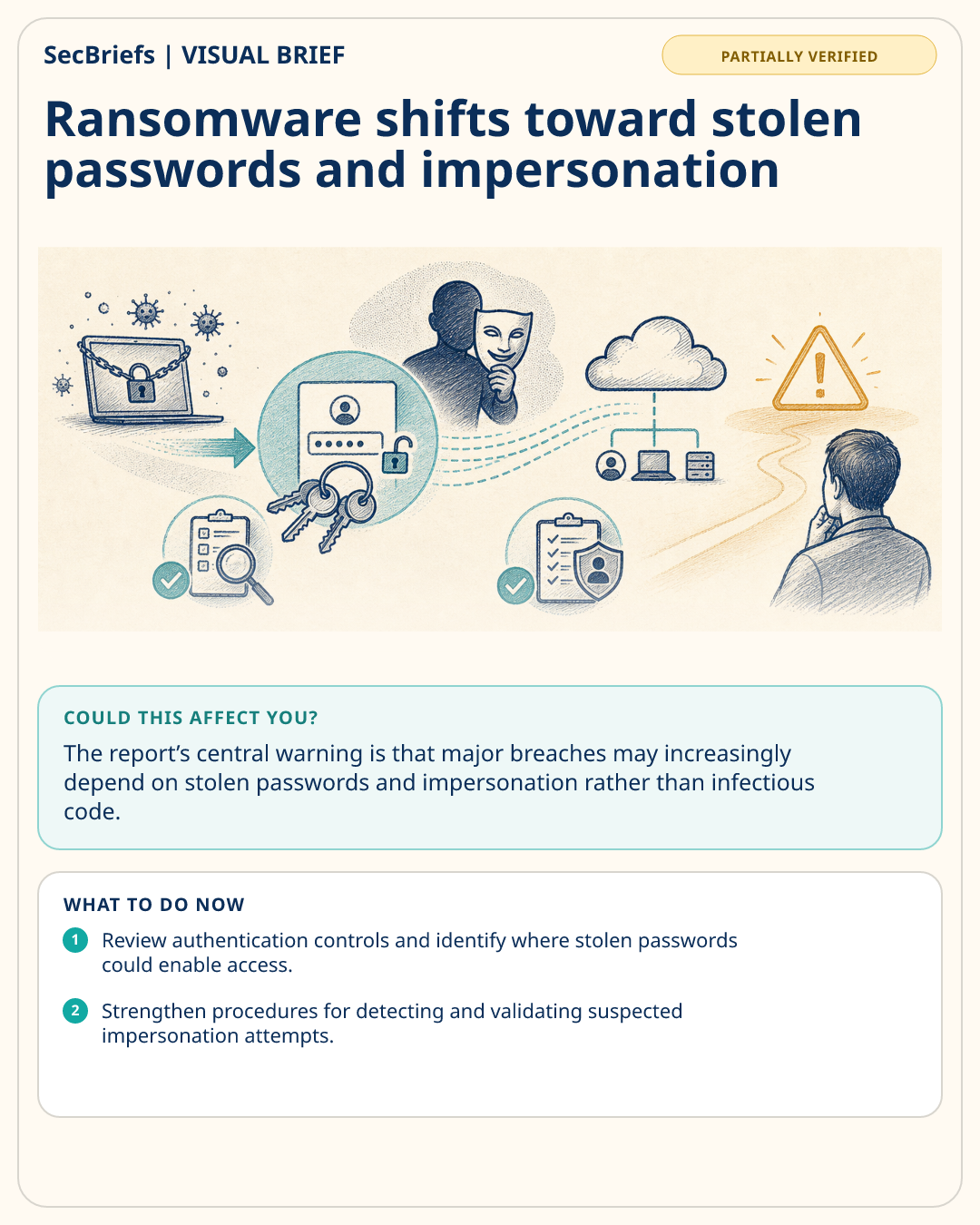
Cybersecurity Dive reports that ransomware is becoming less about malware and more about impersonation. Cloudflare said stolen passwords have replaced infectious code as the most common tactic in major breaches. The supplied account does not provide a specific incident, identify a particular threat actor, quantify the change, or explain how Cloudflare measured the comparison. It does, however, frame a shift in the mechanics associated with major breaches: access can be obtained through stolen credentials rather than through the spread of infectious code. The headline places impersonation at the center of that shift, while the excerpt specifically identifies stolen passwords as the tactic Cloudflare described. Those terms should not be treated as interchangeable without more detail from the source. The report offers a reason for organizations to examine identity and authentication controls as part of ransomware preparedness, but it does not establish that malware has disappeared or that every ransomware event follows this pattern. The supplied facts support a focus on credential abuse and impersonation, while leaving the prevalence and operational details open.
WHY IT MATTERS
The report’s central warning is that major breaches may increasingly depend on stolen passwords and impersonation rather than infectious code. That changes where defenders should look for early signs of compromise and how they frame ransomware readiness. However, the supplied excerpt gives no measurement details beyond Cloudflare’s statement, no named incident, and no claim that malware is no longer used. Organizations should treat the trend as a reported observation, not a complete description of every ransomware operation.
WHO SHOULD CARE
Security leaders, identity teams, help desks, cloud administrators, and incident responders should care because the reported tactic centers on stolen passwords and impersonation. Their controls and investigations should account for credential-based access, while preserving uncertainty about the trend’s precise scale.
WHAT TO DO NOW
- Review authentication controls and identify where stolen passwords could enable access.
- Strengthen procedures for detecting and validating suspected impersonation attempts.
- Include credential-based access scenarios in ransomware exercises and incident-response plans.
- Do not assume malware is absent; compare the reported trend with organization-specific evidence.