ReliaQuest confirms employee social engineering as ShinyHunters claims a larger intrusion
THE BRIEF
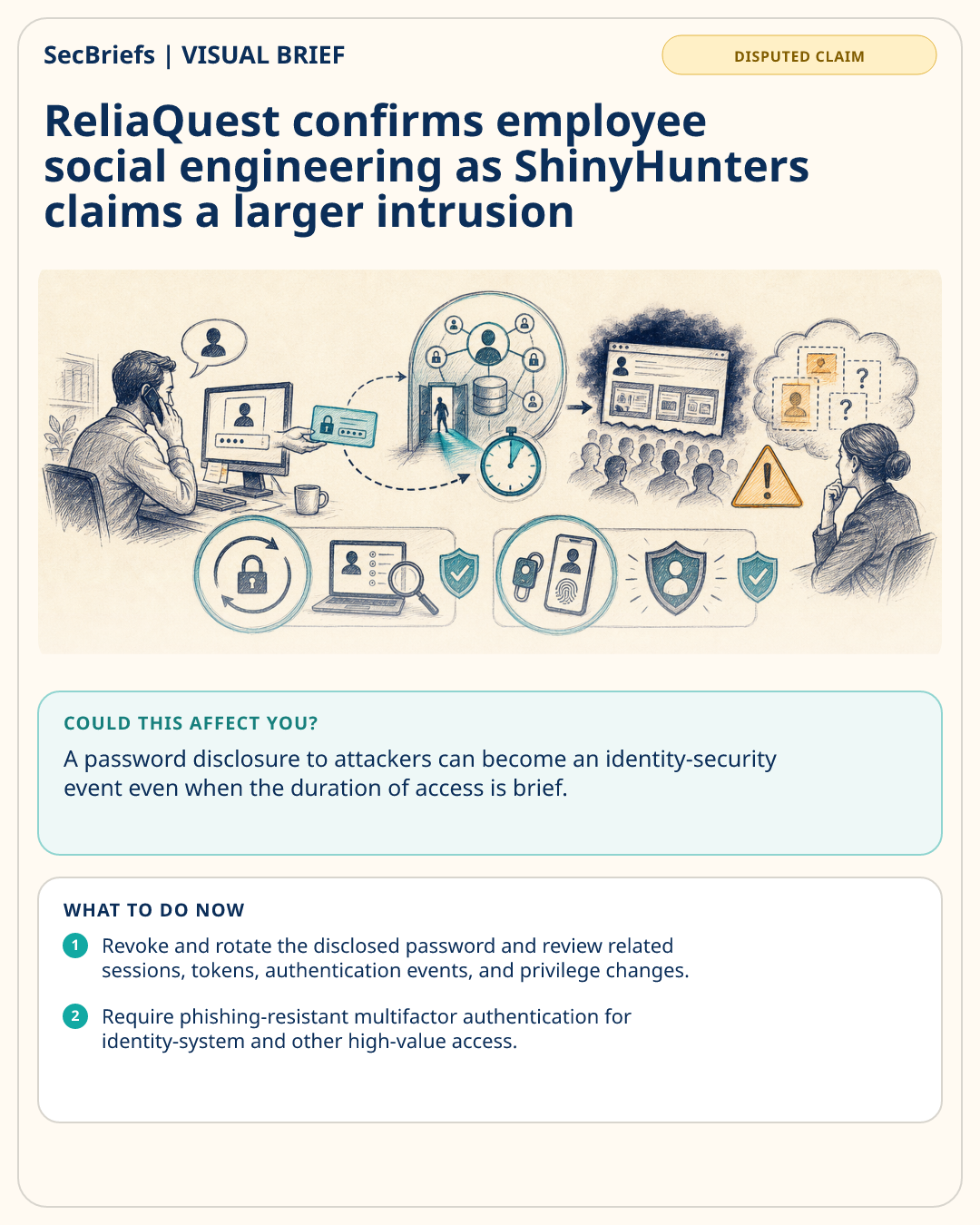
ReliaQuest has confirmed that one of its employees fell for a social engineering attack and handed attackers a password. The supplied report says this created a brief window into the company’s identity system. The incident became public after ShinyHunters posted screenshots on its leak site and claimed a bigger win. Those broader claims, including the extent of any access or data exposure, remain unverified in the supplied material. The report also points to an unusual exchange on X several days earlier, following an August 17 post by ReliaQuest Threat Research about a wider matter. The confirmed portion is therefore limited: an employee was socially engineered, a password was disclosed, and some identity-system access was reportedly available for a short period. The case illustrates how an attacker may use social contact and credential capture to reach identity infrastructure, but it does not establish the number of affected accounts, any data taken, persistence, or downstream harm. Organizations should avoid repeating the extortion group’s larger claims as established facts while reviewing identity controls and social-engineering defenses.
WHY IT MATTERS
A password disclosure to attackers can become an identity-security event even when the duration of access is brief. The supplied facts do not prove broader compromise, data theft, or customer impact, but they show why credential handling, privileged access, and rapid response matter. Banks and other security-sensitive organizations should examine whether a similar employee interaction could bypass normal verification, reach identity services, or delay detection. The incident also reinforces the need to distinguish a confirmed employee action from an attacker’s unverified claims.
WHO SHOULD CARE
CISOs, identity and access teams, security awareness leaders, help-desk managers, fraud teams, and executives responsible for incident communications should review this case. Organizations with privileged employees or public-facing security staff should pay particular attention.
WHAT TO DO NOW
- Revoke and rotate the disclosed password and review related sessions, tokens, authentication events, and privilege changes.
- Require phishing-resistant multifactor authentication for identity-system and other high-value access.
- Reinforce procedures for unusual social-media contact, urgent requests, and attempts to bypass normal verification.
- Preserve relevant messages, identity logs, and screenshots, while documenting which facts are confirmed and which are claims.