Report Describes AI-Linked Surveillance at Beverly Hills High School
THE BRIEF
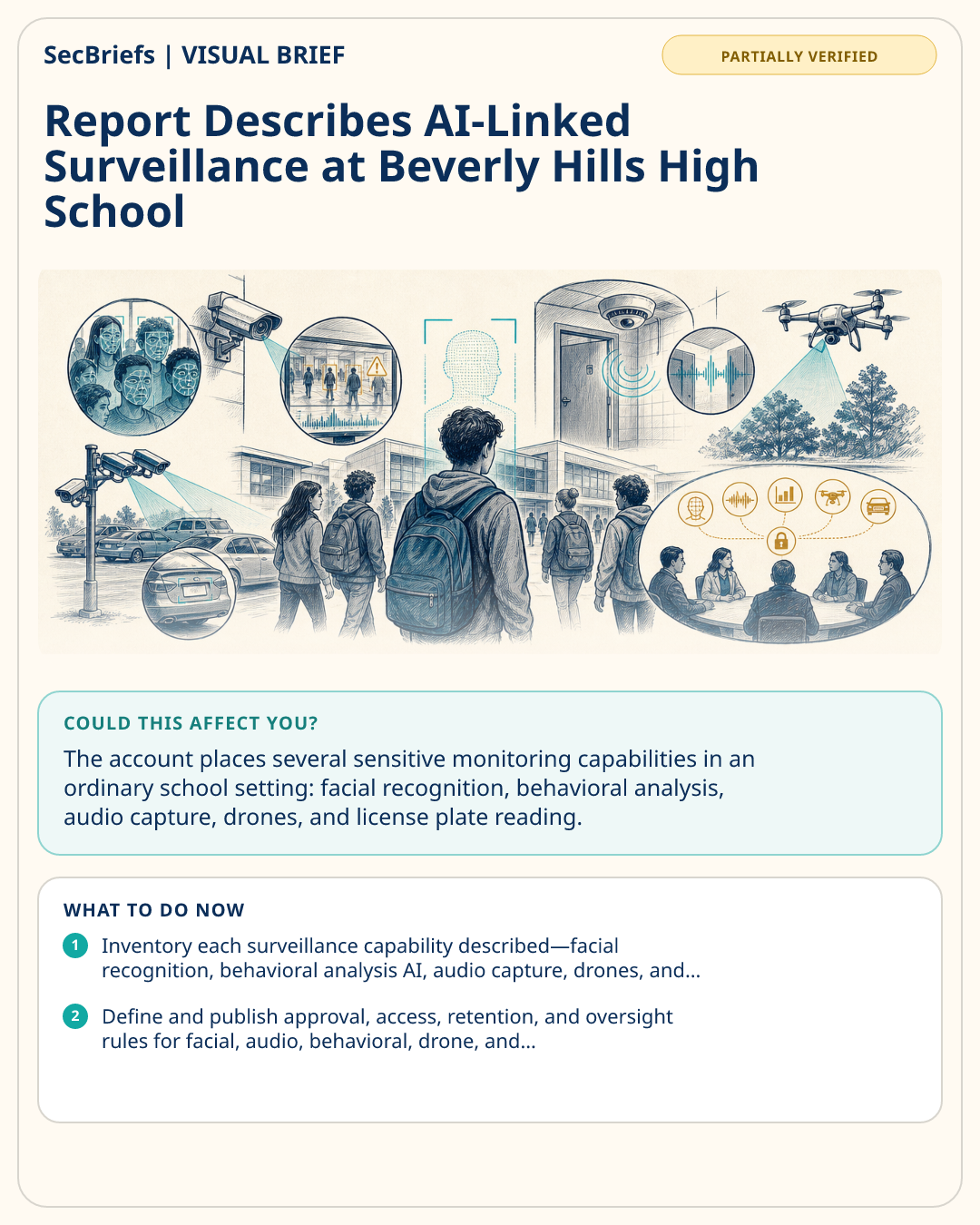
Schneier on Security reports that Beverly Hills High School has a broad set of surveillance technologies. Inside the school, video cameras compare passersby’s faces against a facial recognition database, while behavioral analysis AI reviews footage for signs of violent behavior. A smoke detector-shaped device behind a bathroom door captures audio and listens for sounds of distress. Outside, drones are ready to be deployed for intelligence from above, and Flock Safety’s license plate readers record cars entering and leaving the parking lot to check whether they are driven by criminals. The account describes this as occurring at a school rather than a high-security government facility, raising questions about how schools use facial recognition, behavioral analytics, audio capture, drones, and vehicle monitoring. It does not establish the systems’ accuracy, governance, or outcomes. The report also frames the arrangement as dystopian, but does not provide additional operational detail about deployment or access.
WHY IT MATTERS
The account places several sensitive monitoring capabilities in an ordinary school setting: facial recognition, behavioral analysis, audio capture, drones, and license plate reading. Taken together, these systems could create a complex governance challenge, even though the supplied report does not establish how they are configured, who can access data, how long information is retained, or whether alerts are accurate. School and security leaders therefore need to evaluate the boundaries, oversight, and safeguards surrounding AI-assisted surveillance before treating these tools as routine.
WHO SHOULD CARE
School administrators, educators, parents, students, privacy officers, security teams, and policymakers should care. The report is especially relevant to anyone responsible for approving, operating, overseeing, or challenging surveillance technologies in educational settings.
WHAT TO DO NOW
- Inventory each surveillance capability described—facial recognition, behavioral analysis AI, audio capture, drones, and license plate readers—and document its purpose and operating boundaries.
- Define and publish approval, access, retention, and oversight rules for facial, audio, behavioral, drone, and vehicle-monitoring data before expanding use.
- Test and document alert accuracy and review procedures for claimed signs of violent behavior, sounds of distress, and vehicle checks.