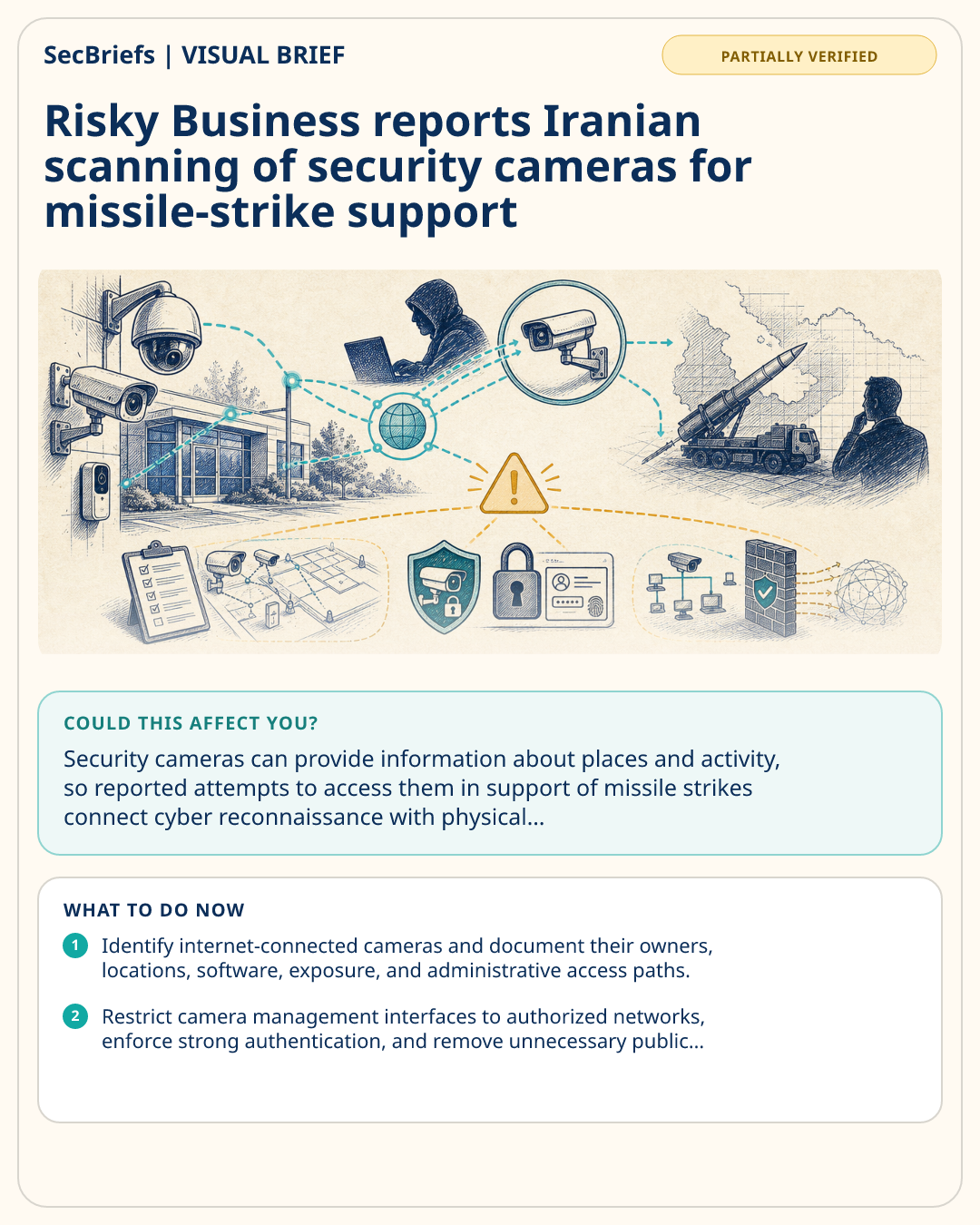
Risky Business reports Iranian scanning of security cameras for missile-strike support
THE BRIEF
Risky Business News reports that Iran is attempting to hack security cameras to support its missile strikes. The supplied episode description characterizes the activity as scanning for security cameras, but it does not specify which cameras or networks were targeted, how access was obtained, whether any systems were compromised, or how camera information would be used operationally. It also does not identify a specific Iranian organization or provide independent confirmation of the activity. The same description says the episode covers Israel bombing Iran’s cyber headquarters, authorities taking down LeakBase and Tycoon 2FA, and TikTok saying no to encrypted private messaging. Those topics are listed as show notes, while the supplied headline focuses on the camera-scanning report. The available facts therefore support attention to the possibility of cyber activity involving physical-security systems and military operations, without establishing the scale, success, or consequences of the reported attempts. The item was published by Risky Business News on March 6, 2026, and is presented as part of Risky Bulletin episode 534.
WHY IT MATTERS
Security cameras can provide information about places and activity, so reported attempts to access them in support of missile strikes connect cyber reconnaissance with physical military operations. However, the supplied account does not establish that cameras were successfully hacked, identify targets, or describe any resulting strike or damage. The uncertainty is important: defenders should prepare for attempts to exploit connected surveillance systems without treating the report as proof of a completed compromise. Camera inventories, access controls, monitoring, and segmentation remain relevant defensive questions for organizations operating exposed devices.
WHO SHOULD CARE
Organizations operating internet-connected security cameras, military and public-sector security teams, critical-infrastructure defenders, and physical-security leaders should care. Intelligence analysts should distinguish reported scanning attempts from confirmed compromise or operational impact.
WHAT TO DO NOW
- Identify internet-connected cameras and document their owners, locations, software, exposure, and administrative access paths.
- Restrict camera management interfaces to authorized networks, enforce strong authentication, and remove unnecessary public exposure.
- Monitor camera systems and network boundaries for unusual scanning, login attempts, configuration changes, or unexpected outbound connections.