ServiceNow patches three critical AI Platform flaws
THE BRIEF
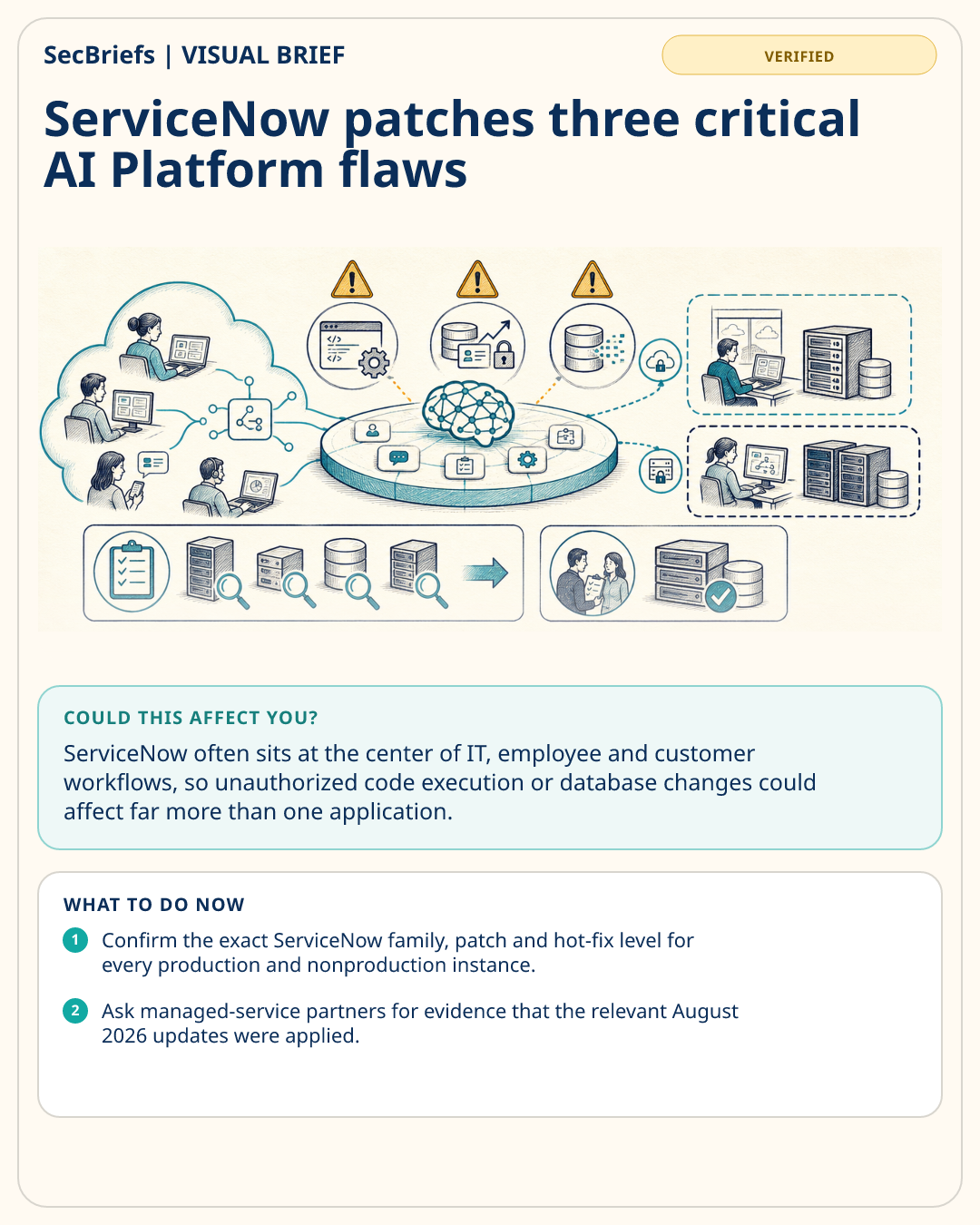
ServiceNow has issued fixes for three critical vulnerabilities in its AI Platform that could expose enterprise workflows and data to unauthenticated attack. CSO Online reports that CVE-2026-18885 can permit remote code execution and data access or modification, CVE-2026-18886 can allow changes to instance data and privilege escalation, and CVE-2026-74820 can enable arbitrary SQL statements against an instance database. All three received the maximum CVSS v4.0 score of 10.0. ServiceNow also addressed a high-severity AI sandbox escape tracked as CVE-2026-6876. The vendor says hosted instances received security updates and patches were made available to self-hosted customers, partners and hosted customers with special configurations. ServiceNow was not aware of exploitation when it published the advisory. Organizations should therefore avoid presenting this as an active breach campaign, but self-hosted environments still require prompt version and patch verification. The most useful action is to confirm whether every instance—including development, test and partner-managed systems—is covered by the relevant update.
WHY IT MATTERS
ServiceNow often sits at the center of IT, employee and customer workflows, so unauthorized code execution or database changes could affect far more than one application. Cloud customers may already be protected, but organizations frequently maintain self-hosted, nonproduction or specially configured instances that do not follow the standard hosted update path. Three maximum-severity flaws arriving together justify an inventory check, evidence of completed remediation and focused monitoring even without known exploitation. The distinction between hosted and self-hosted responsibility is the operational issue that matters most.
WHO SHOULD CARE
ServiceNow platform owners, vulnerability managers, cloud and application security teams, IT service-management leaders, auditors and organizations using partner-managed or self-hosted instances should verify coverage. directly
WHAT TO DO NOW
- Confirm the exact ServiceNow family, patch and hot-fix level for every production and nonproduction instance.
- Ask managed-service partners for evidence that the relevant August 2026 updates were applied.
- Review administrative and database activity for unexpected changes, especially on externally reachable or self-hosted instances.
- Restrict management access and remove unnecessary public exposure while remediation is being confirmed.
- Track ServiceNow’s advisory for exploitation updates and revised indicators.
VERIFICATION NOTE
CSO Online reporting is verified against ServiceNow’s official August 2026 CVE advisory. ServiceNow says hosted instances were updated and it was not aware of exploitation at publication.