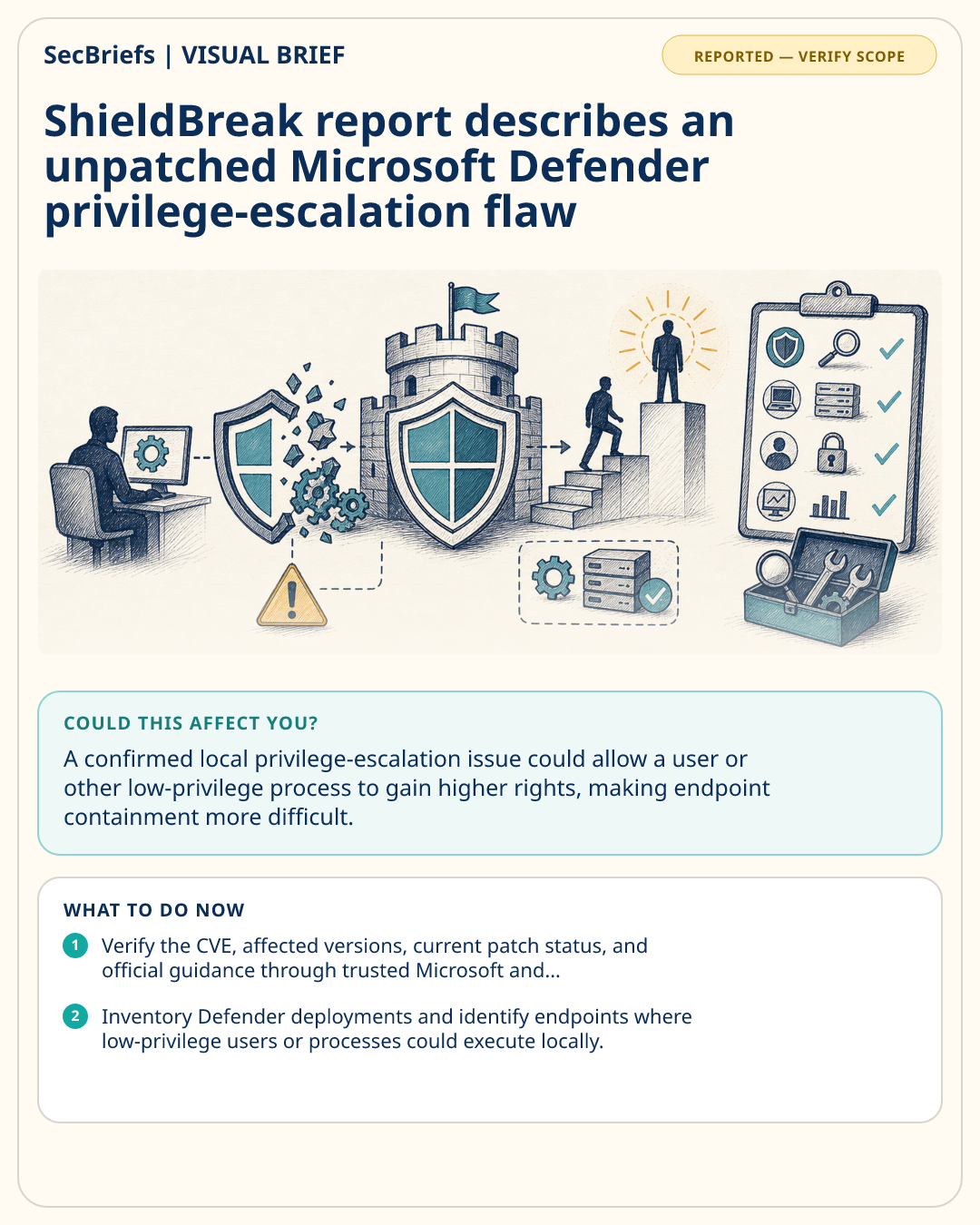
ShieldBreak report describes an unpatched Microsoft Defender privilege-escalation flaw
THE BRIEF
A report from Qualys describes ShieldBreak, identified as CVE-2026-69414, as a zero-day elevation-of-privilege vulnerability in the Microsoft Malware Protection Engine used by Microsoft Defender. According to the supplied description, a low-privilege local attacker could escalate to SYSTEM. The report says a public proof of concept was released on August 12, Microsoft assigned the CVE on August 14, and no patch was available when the report was published. It also references detection and mitigation through a security product. These technical and status details come from the supplied report and carry an unverified status here. The material does not establish how many systems are affected, whether exploitation has occurred in the wild, which Defender versions are vulnerable, or whether any organization has been compromised. It also does not establish that the described mitigation is effective in every environment. Security teams should treat the report as a lead for validation rather than as proof of active attacks or impact. They should confirm Microsoft’s current guidance, identify affected systems if confirmed, and assess local exposure to low-privilege accounts and public proof-of-concept activity.
WHY IT MATTERS
A confirmed local privilege-escalation issue could allow a user or other low-privilege process to gain higher rights, making endpoint containment more difficult. However, the supplied verification status is unverified, and there is no supplied evidence of exploitation, victims, or consequences. The prudent response is validation: check authoritative vendor guidance, map Defender deployments, limit unnecessary local privileges, and prepare monitoring. Avoid presenting the alleged vulnerability or its patch status as settled until independently confirmed.
WHO SHOULD CARE
Endpoint engineering, vulnerability management, Windows platform teams, threat hunters, SOC leaders, and risk owners should track this report. It is especially relevant where Microsoft Defender is widely deployed and local privilege is tightly controlled.
WHAT TO DO NOW
- Verify the CVE, affected versions, current patch status, and official guidance through trusted Microsoft and vulnerability-management channels.
- Inventory Defender deployments and identify endpoints where low-privilege users or processes could execute locally.
- Review endpoint telemetry for unexpected privilege changes, SYSTEM processes, and suspicious local execution tied to the reported timeframe.