SmarterTools Reportedly Hacked Through Vulnerabilities in Its Own Product
THE BRIEF
Risky Business News reports that SmarterTools, a software company, was hacked through vulnerabilities in its own product. The item is presented in a broader Risky Bulletin covering several unrelated developments, including European agencies reportedly hacked through recent Ivanti zero-days, an extortion incident involving Senegal, and a state actor’s Signal phishing campaign in Germany. For SmarterTools, the supplied report does not identify the vulnerable product, describe the flaws, say when the intrusion occurred, or explain what systems or information may have been affected. It also does not provide details about the suspected attacker, the number of organizations involved, or the company’s response. The central reported point is that weaknesses in software developed by the company were used as the route into the organization. Readers should therefore treat this as an initial report from Risky Business News and avoid inferring breach scope or impact beyond that statement. Further technical, victim, and remediation details would be needed to assess the incident fully.
WHY IT MATTERS
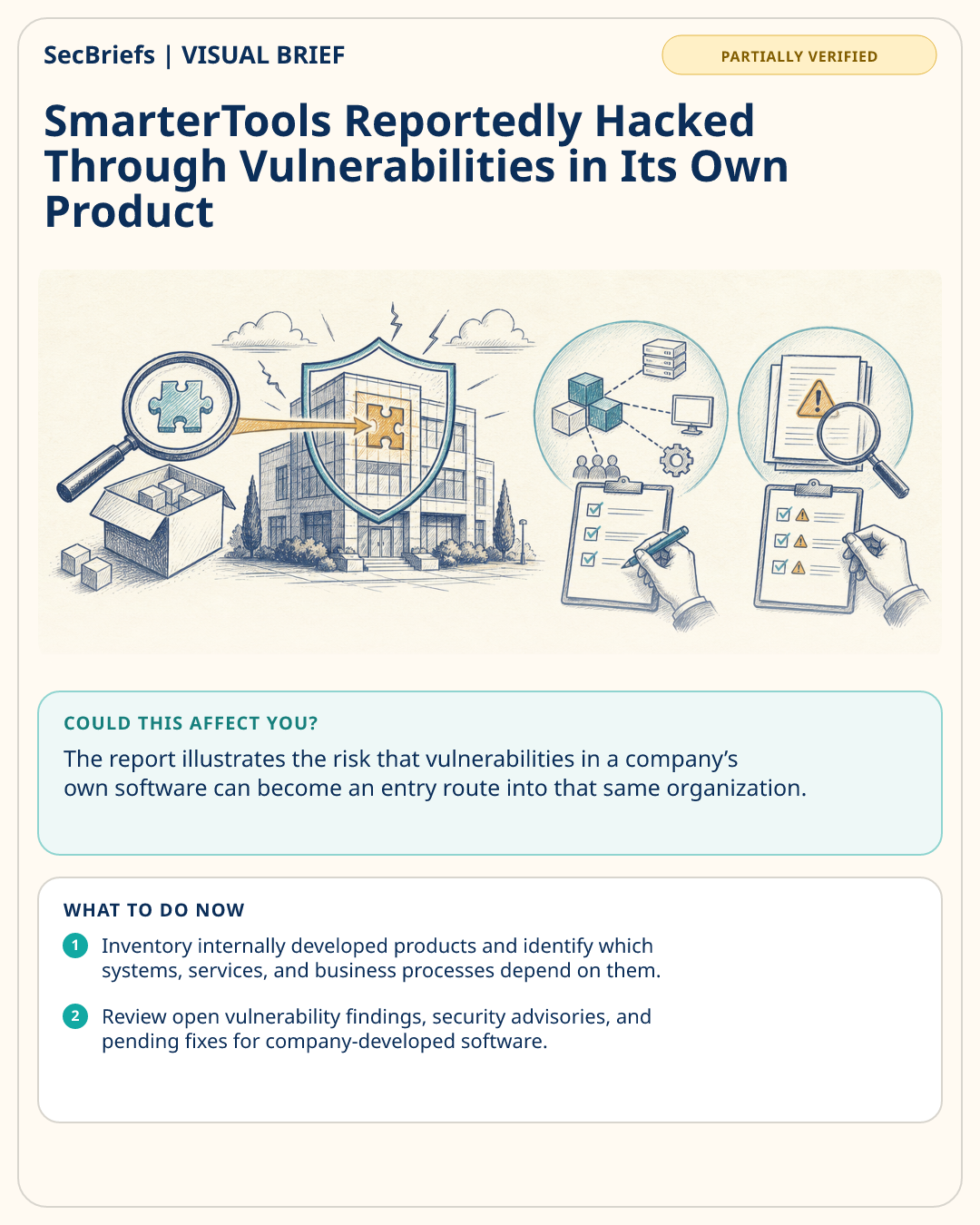
The report illustrates the risk that vulnerabilities in a company’s own software can become an entry route into that same organization. It also underscores the importance of treating internally developed products as part of the security boundary, not only as business tools. However, the supplied account contains no details about the flaw, affected systems, exploitation method, or consequences. Security teams should use the report as a prompt to review exposure and product-security processes, rather than as evidence of a defined incident scope.
WHO SHOULD CARE
Software companies, product-security teams, security leaders, and defenders responsible for internally developed applications should take note. Organizations that build or operate business software can use the report to review how product vulnerabilities are identified, prioritized, and monitored.
WHAT TO DO NOW
- Inventory internally developed products and identify which systems, services, and business processes depend on them.
- Review open vulnerability findings, security advisories, and pending fixes for company-developed software.
- Confirm that product-security teams and incident responders can quickly share information about suspected exploitation.
- Increase monitoring for unusual activity involving systems that host or support internally developed applications.