Unit 42 examines AI-enabled malware from brand abuse to agentic execution
THE BRIEF
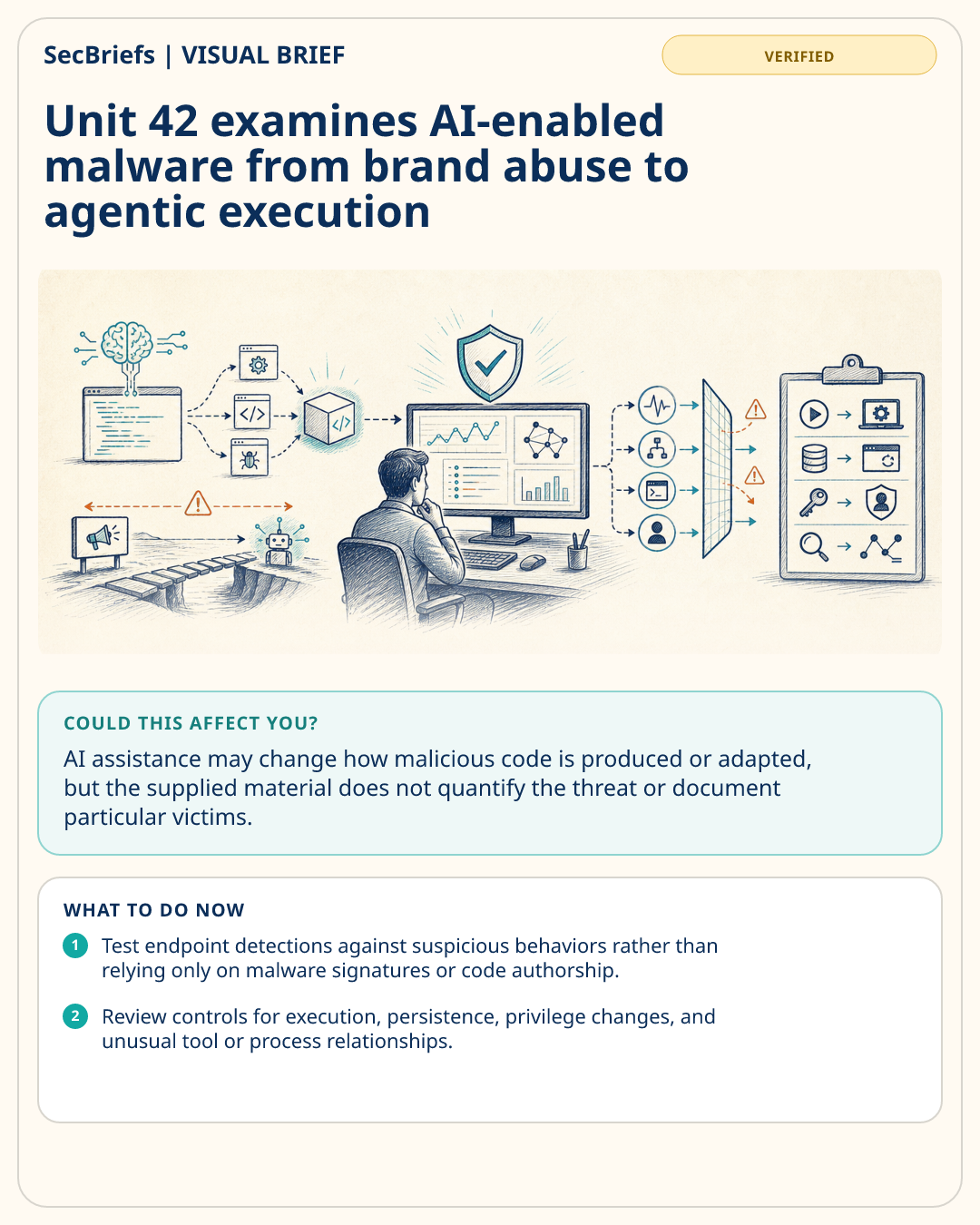
Unit 42’s supplied research examines AI-enabled malware, covering activity described as ranging from brand abuse to agentic execution. The research also addresses how existing behavioral detection and endpoint analytics can stop AI-authored code before execution. The candidate is marked verified because it is presented as primary research from Unit 42. The supplied excerpt does not provide specific malware names, affected organizations, attack counts, confirmed victims, or evidence that autonomous malware has caused a particular incident. It also does not establish that every form of AI-authored code is malicious or that existing defenses will stop all such activity. The useful takeaway is narrower: security teams should consider how behavior-based controls and endpoint analytics perform when code is generated or modified with AI assistance. Organizations can use the research as a prompt to test detection against behaviors rather than relying only on known samples or authorship clues. They should also keep claims about “agentic” execution tied to the research’s documented examples and definitions. The supplied facts support defensive review, not a conclusion that AI has created a new, measured level of operational harm.
WHY IT MATTERS
AI assistance may change how malicious code is produced or adapted, but the supplied material does not quantify the threat or document particular victims. The verified research is valuable as a defensive prompt: endpoint controls should detect suspicious behavior, not depend solely on code provenance. Security leaders should test whether analytics identify execution chains, persistence, privilege changes, and other risky actions. This approach remains useful whether code was written by a person, generated by AI, or modified through both.
WHO SHOULD CARE
CISOs, SOC and endpoint teams, threat hunters, detection engineers, security architects, and application-security leaders should review the research. Executives overseeing AI adoption should coordinate defensive testing with governance and monitoring.
WHAT TO DO NOW
- Test endpoint detections against suspicious behaviors rather than relying only on malware signatures or code authorship.
- Review controls for execution, persistence, privilege changes, and unusual tool or process relationships.
- Measure detection and response performance in controlled exercises using approved AI-generated test code.
- Align AI security research with existing malware, endpoint, and threat-hunting governance.