Why Human Teams Struggle to Get Value from Agentic AI
THE BRIEF
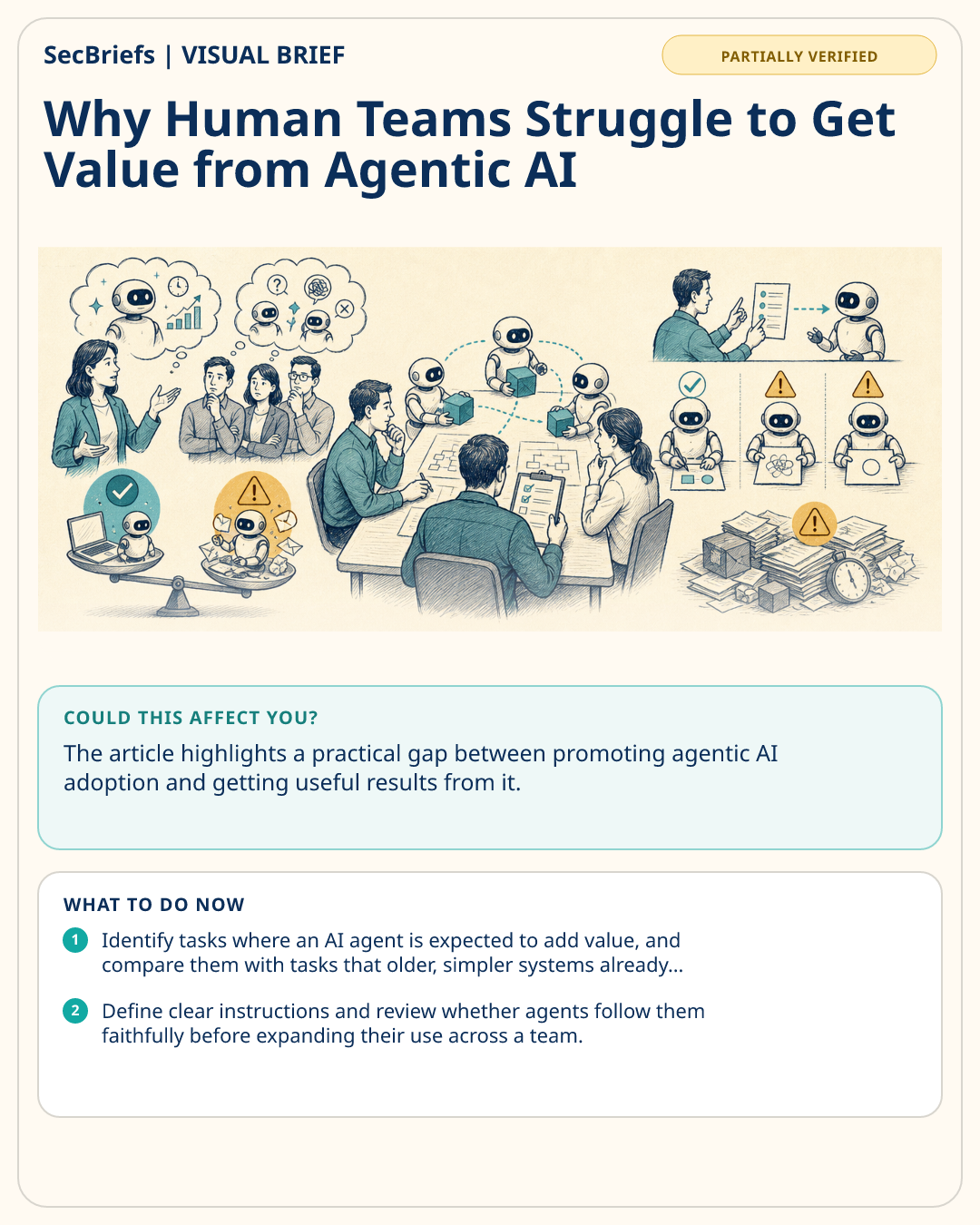
Schneier on Security examines why many organizations are urging teams to adopt agentic AI while struggling to achieve meaningful benefits. The article says managers adding AI agents to existing human teams may encounter bots that do not faithfully follow instructions, produce pointless or obvious results, or spend valuable time and resources on tasks that older, simpler systems could handle just as well. It also reports that technical innovators getting the most from AI are finding the technology remarkably human in its behavior. According to the article, those human-like dynamics become more apparent when groups of AI agents are assigned work requiring cooperation and collaboration. The broader argument is that organizations should think carefully about how digital workers operate alongside people, rather than treating agentic AI as a straightforward efficiency upgrade. Schneier on Security suggests that leaders who understand the dynamics of hybrid human-and-digital teams may be especially effective as these systems become more common.
WHY IT MATTERS
The article highlights a practical gap between promoting agentic AI adoption and getting useful results from it. Poorly matched tasks, weak adherence to instructions, obvious outputs, and wasted resources can limit the value of deployments. Its emphasis on cooperation among AI agents also suggests that managing these systems may involve more than selecting a tool. Organizations considering hybrid teams of people and digital workers may need leadership approaches that account for how the systems behave and interact, rather than assuming automation will automatically improve efficiency.
WHO SHOULD CARE
Security and technology leaders evaluating agentic AI, managers integrating digital workers into existing teams, and organizations deciding which tasks should be handled by AI agents or simpler systems should pay attention to these observations.
WHAT TO DO NOW
- Identify tasks where an AI agent is expected to add value, and compare them with tasks that older, simpler systems already handle effectively.
- Define clear instructions and review whether agents follow them faithfully before expanding their use across a team.
- Track whether agents produce useful results or consume unnecessary time and resources during assigned work.
- Evaluate how groups of AI agents cooperate with one another and with human teammates when work requires collaboration.