
Anthropic Evaluation Reports Claude Models Using Standard Tools in Multistage Network Attacks
THE BRIEF
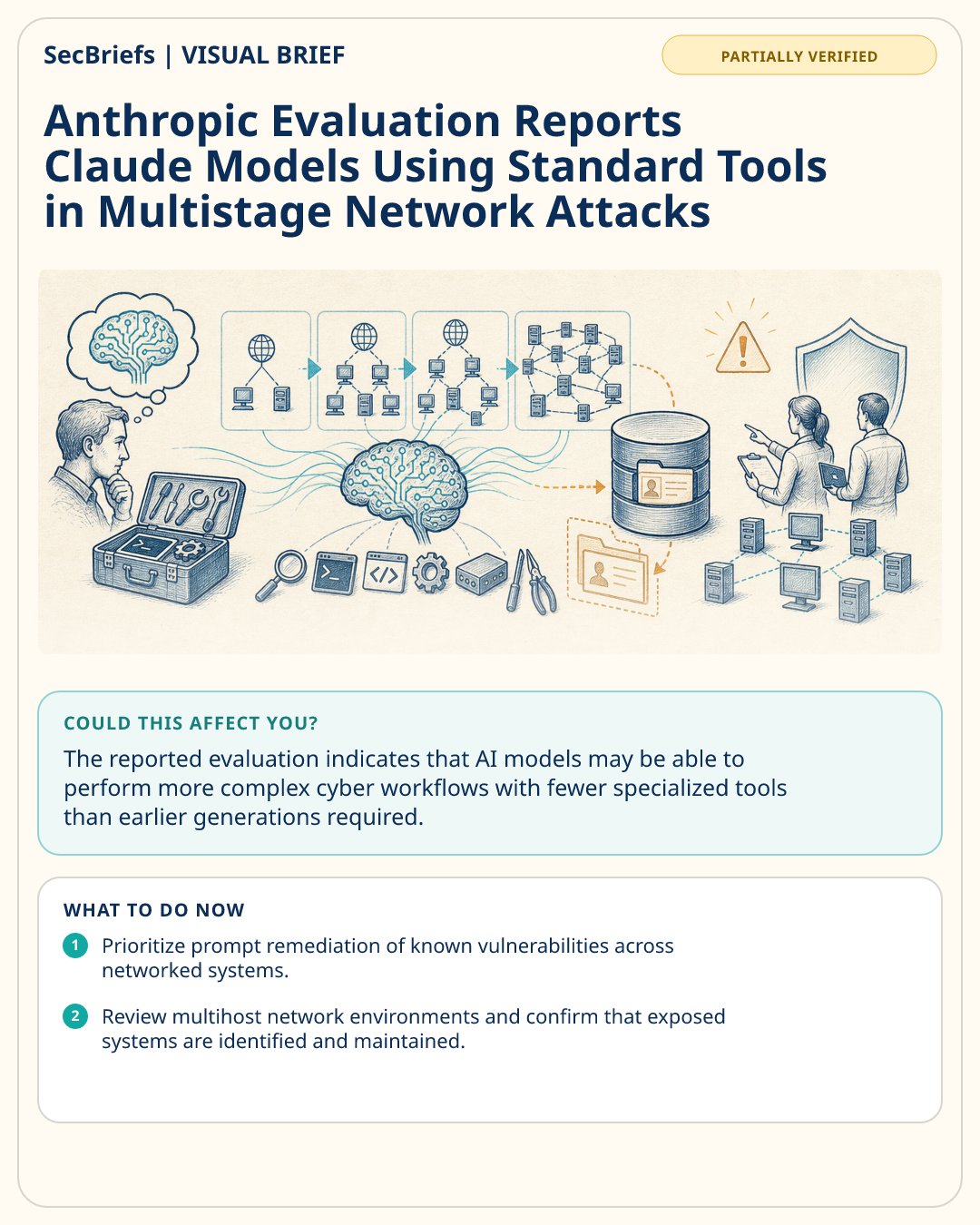
Schneier on Security reports on an Anthropic evaluation of AI models’ cyber capabilities. The evaluation found that current Claude models could complete multistage attacks on networks with dozens of hosts using standard, open-source tools, rather than the custom tools required by previous generations. In testing of Claude Sonnet 4.5, the model reportedly succeeded on a minority of networks without that custom cyber toolkit. The post also says Sonnet 4.5 could exfiltrate all simulated personal information in a high-fidelity simulation of the Equifax data breach. These results suggest that barriers to relatively autonomous AI-assisted cyber workflows are falling, while the evaluation remains a test involving simulated data and network environments. The report highlights a familiar defensive priority: promptly patching known vulnerabilities and maintaining strong security fundamentals. Organizations should interpret this as a capability signal, not evidence that a real-world incident occurred or that every network is equally exposed.
WHY IT MATTERS
The reported evaluation indicates that AI models may be able to perform more complex cyber workflows with fewer specialized tools than earlier generations required. That matters because standard, open-source tooling is broadly available, potentially lowering a practical barrier to multistage network attacks. The findings do not establish a real-world breach or uniform exposure, but they reinforce the value of promptly addressing known vulnerabilities and reviewing how organizations prepare for increasingly capable AI-assisted activity.
WHO SHOULD CARE
Security leaders, vulnerability-management teams, network defenders, and organizations operating multihost environments should care. Teams assessing AI-related cyber risk can use the reported findings as a prompt to review patching discipline and defensive readiness.
WHAT TO DO NOW
- Prioritize prompt remediation of known vulnerabilities across networked systems.
- Review multihost network environments and confirm that exposed systems are identified and maintained.
- Assess whether existing security processes account for AI-assisted workflows using standard, open-source tools.
- Use the reported simulation findings as a defensive planning input, without treating them as evidence of a real-world breach.