Bitwarden CLI npm package compromise exposed developer credentials
THE BRIEF
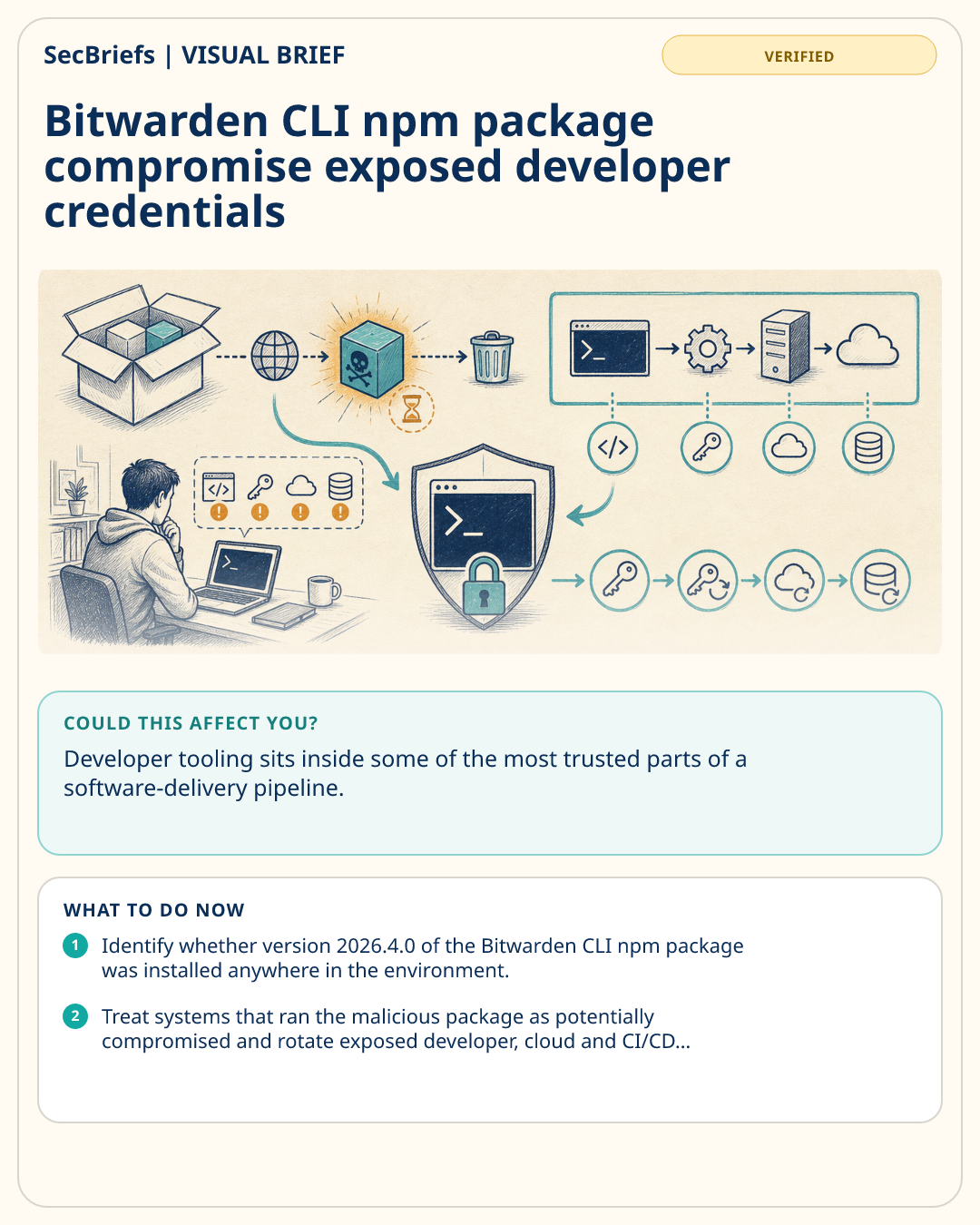
Bitwarden confirmed that a malicious version of its official CLI package was briefly distributed through npm after attackers compromised the package-distribution channel. The affected release, version 2026.4.0, contained credential-stealing code and was available for roughly ninety minutes before removal. Bitwarden said the incident was limited to the npm distribution path for its CLI package and found no evidence that end-user vault data, production systems or production data were compromised. Researchers linked the malicious package to a broader developer-focused supply-chain campaign and warned that systems which installed the affected version should be treated as compromised. The practical risk is concentrated in developer environments because CLI tools often run near source code, CI/CD credentials, cloud tokens and repository access. That makes even a short-lived package compromise potentially important: a malicious build does not need to reach every customer if it lands on machines that hold privileged automation credentials or can publish additional software downstream.
WHY IT MATTERS
Developer tooling sits inside some of the most trusted parts of a software-delivery pipeline. A compromised official package can inherit the trust normally given to a well-known vendor and reach credentials that are more powerful than an ordinary end-user password. The incident also shows why package-version provenance and rapid credential rotation matter even when the vendor’s core service is unaffected. The same principle applies to any trusted developer package distributed through a third-party registry.
WHO SHOULD CARE
Software-development teams, DevSecOps, CI/CD administrators and organizations that installed the Bitwarden CLI from npm should care, especially where developer workstations hold cloud, repository or deployment credentials.
WHAT TO DO NOW
- Identify whether version 2026.4.0 of the Bitwarden CLI npm package was installed anywhere in the environment.
- Treat systems that ran the malicious package as potentially compromised and rotate exposed developer, cloud and CI/CD credentials.
- Review package-lock files, build logs and artifact histories for use of the affected version.
- Separate trust in the Bitwarden service from trust in individual software-distribution channels when assessing impact.