Google patched Chrome zero-day CVE-2026-5281 after exploitation in the wild
THE BRIEF
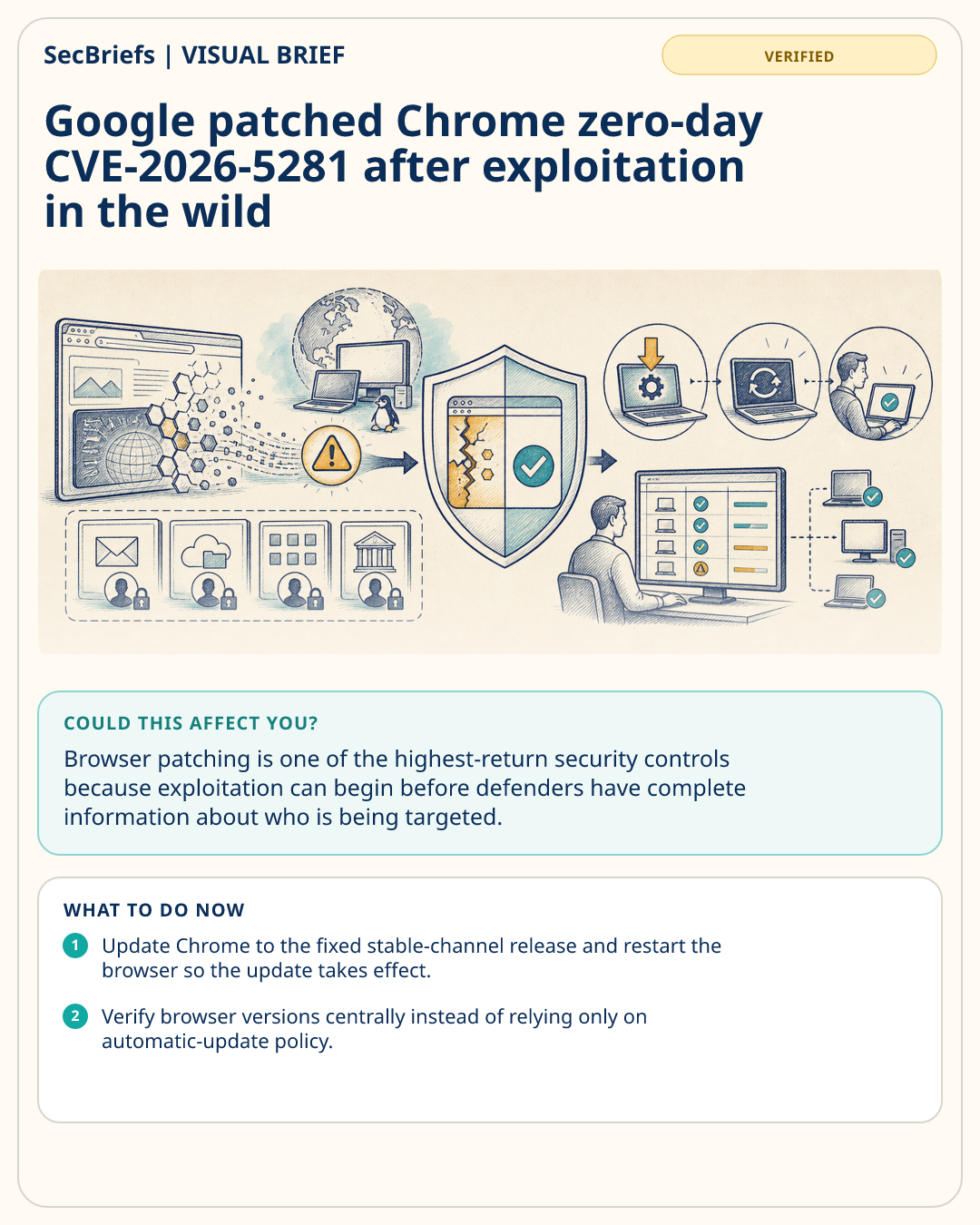
Google released an emergency Chrome update for CVE-2026-5281 after confirming that an exploit for the vulnerability existed in the wild. The flaw was a use-after-free issue in Dawn, the Chromium project’s cross-platform implementation of the WebGPU standard. Google did not disclose details of the observed attacks, a common practice while a large share of users are still applying a fix. Stable-channel updates were released for Windows, macOS and Linux, with rollout versions in the Chrome 146.0.7680.177/178 range. BleepingComputer noted that this was the fourth Chrome zero-day patched as actively exploited since the beginning of 2026. Earlier exploited flaws that year affected CSS font handling, Skia graphics and the V8 JavaScript/WebAssembly engine. The repeated emergency updates reinforce that browsers remain high-value targets because they process untrusted web content while holding authenticated sessions to email, cloud applications, banking and enterprise services. globally.
WHY IT MATTERS
Browser patching is one of the highest-return security controls because exploitation can begin before defenders have complete information about who is being targeted. Organizations often focus on operating-system patch cycles while browsers update on a different cadence and may remain open for days without restarting. A zero-day in a widely deployed browser can therefore create a large exposure window even when the fix is already available. Managed environments should verify actual deployed versions rather than assuming automatic updates have completed, especially on devices with privileged access to cloud consoles or sensitive data.
WHO SHOULD CARE
Every Chrome user is affected operationally, but enterprise endpoint teams, privileged administrators, finance users and organizations with large unmanaged browser populations should care most. This includes teams managing shared kiosks, contractors and remote endpoints.
WHAT TO DO NOW
- Update Chrome to the fixed stable-channel release and restart the browser so the update takes effect.
- Verify browser versions centrally instead of relying only on automatic-update policy.
- Prioritize patching on endpoints used for privileged administration, finance and sensitive cloud access.
- Monitor for emergency browser advisories as a separate patch stream from normal operating-system maintenance.