StreamRat Android Malware Spreads Through Meta and TikTok Ads
BRIEF
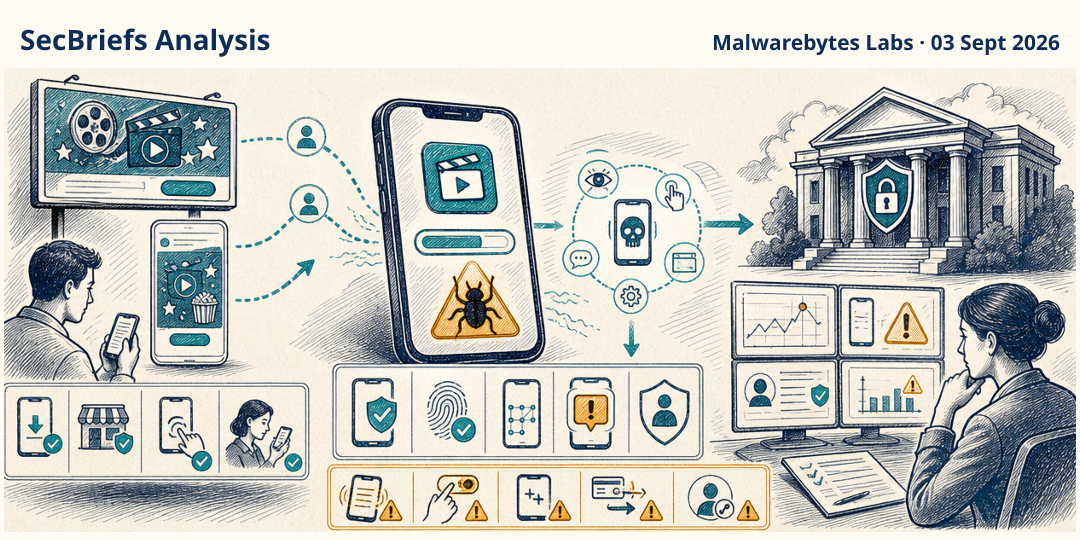
Malwarebytes reports that advertisements on Meta and TikTok promoting a free streaming service exposed roughly 570,000 people to StreamRat, an Android banking Trojan. The research describes the malware as capable of taking control of infected phones. The supplied facts do not establish how many devices were infected, which banking applications were targeted, the precise delivery flow, or the financial losses involved. Exposure should therefore not be equated with compromise. The distribution path is still important because advertising on familiar platforms can make a malicious offer appear more credible and can reach users outside an organization’s managed-device estate. Banks should consider the issue in both customer protection and employee-device contexts. Mobile risk controls may include device-integrity signals, detection of unusual accessibility or overlay behavior, step-up verification for sensitive actions, and rapid response to suspicious sessions. Customer communications should focus on safe app installation and avoiding unofficial streaming offers without repeating unverified infection counts as confirmed victims. Fraud teams can look for changes in device behavior, new device enrollment, unusual transaction sequences, or account-recovery activity associated with Android sessions. Organizations should also confirm that mobile incident playbooks cover customer reports of remote control, not only credential theft.
WHY IT MATTERS
Banking malware on phones can undermine the separation between login, approval, and transaction activity. A compromised device may give an attacker a more convincing path to abuse sessions or persuade a customer to authorize actions, although the supplied material does not quantify that risk for StreamRat specifically. The reported advertising route expands the social-engineering surface. Banks should combine mobile telemetry, transaction analytics, customer support, and education rather than rely on passwords or one-time codes alone.
WHO SHOULD CARE
Digital banking, mobile-app security, fraud analytics, customer protection, threat intelligence, and communications teams should coordinate. Employers should also review whether unmanaged Android devices are used for privileged access or approval workflows.
WHAT TO DO
- Monitor Android sessions for device-integrity changes, abnormal accessibility or overlay behavior, new-device enrollment, and unusual account-recovery or transaction patterns.
- Review controls for high-risk actions when the device is suspected of compromise, including step-up verification, transaction holds, and customer confirmation through a trusted channel.
- Update customer guidance to discourage installing unofficial streaming applications and to explain how to report suspected device takeover.
- Ensure support and fraud teams can link mobile-device signals with account and transaction events without treating reported exposure as proof of infection.
- Validate that employee or administrator workflows do not rely solely on a potentially compromised personal Android device for approval or authentication.
TECHNICAL DETAILS
The supplied malware-research source reports exposure through Meta and TikTok ads and describes banking-trojan capabilities affecting mobile users.