TrueConf zero-day let attackers push malicious updates to connected endpoints
THE BRIEF
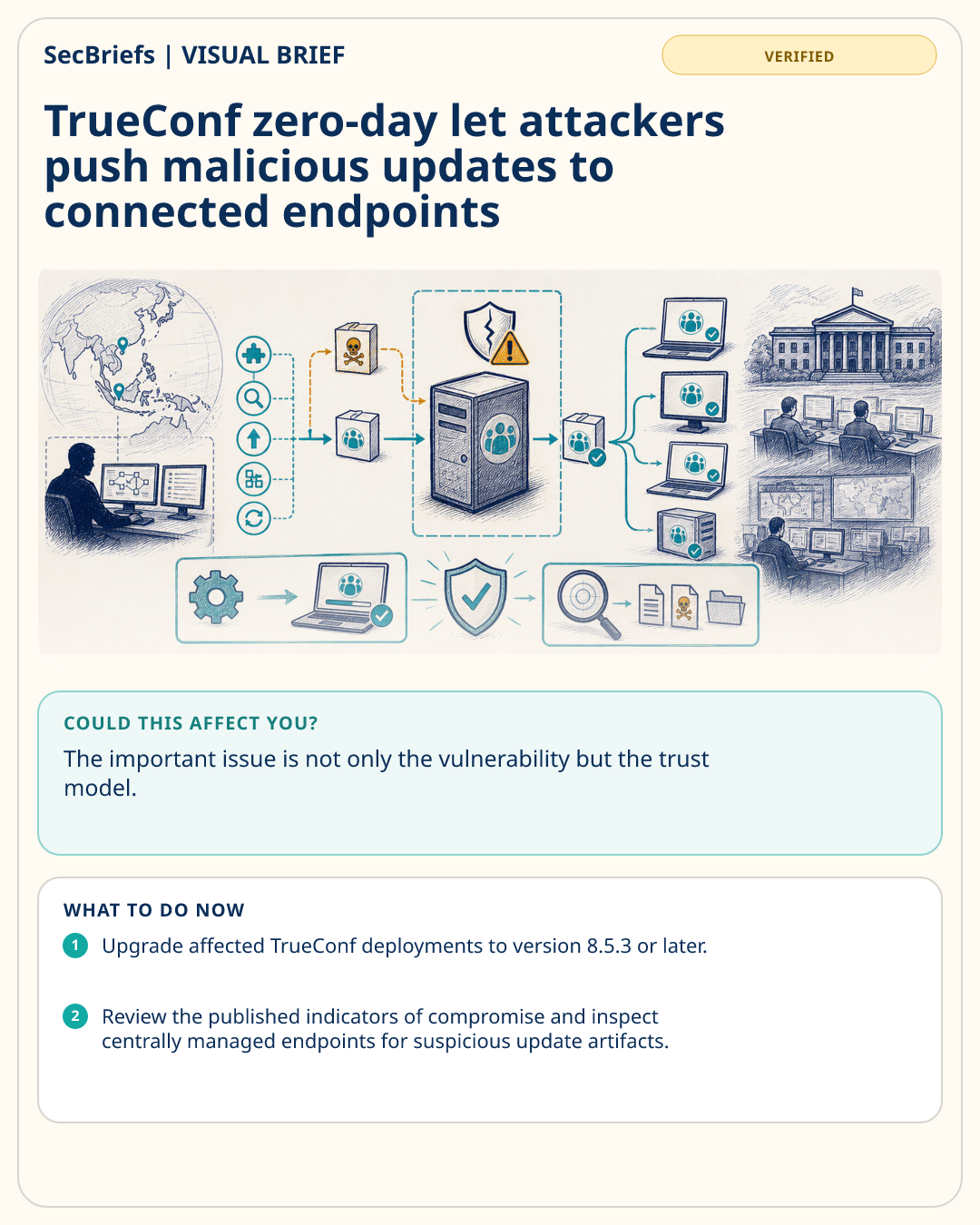
Check Point researchers reported active exploitation of CVE-2026-3502, a flaw in the update mechanism of self-hosted TrueConf conferencing servers. The weakness arose from insufficient integrity validation, meaning an attacker who controlled a vulnerable on-premises server could replace the expected client update with an arbitrary executable and distribute it to connected endpoints as though it were legitimate software. Check Point tracked a campaign called TrueChaos that targeted government entities in Southeast Asia and said the activity exploited the flaw before public disclosure. The researchers assessed with moderate confidence that the operation was linked to a China-nexus actor, based on infrastructure, victimology and tactics. The attack chain included DLL sideloading, reconnaissance, privilege escalation and persistence. TrueConf versions 8.1.0 through 8.5.2 were affected; the vendor released version 8.5.3 in March 2026. Researchers also published indicators that defenders can use to look for compromise.
WHY IT MATTERS
The important issue is not only the vulnerability but the trust model. Enterprise software-update channels are treated as authoritative, so compromise of a central management server can convert normal administration into a delivery mechanism for malware across many endpoints at once. Organizations running self-hosted collaboration systems often place them in sensitive or isolated environments precisely because they want tighter control. That makes integrity verification, rapid patching and compromise assessment of the management server critical, especially where government or critical infrastructure users are involved.
WHO SHOULD CARE
Government agencies, operators of self-hosted conferencing systems, critical-infrastructure organizations, endpoint teams and administrators responsible for software distribution should care. Security architects responsible for trusted update channels and administrative servers should also pay attention.
WHAT TO DO NOW
- Upgrade affected TrueConf deployments to version 8.5.3 or later.
- Review the published indicators of compromise and inspect centrally managed endpoints for suspicious update artifacts.
- Treat a compromised management server as a potential compromise of every client that trusted its updates.
- Separate update-signing and integrity validation from administrative trust wherever the platform supports it.