Berlin refuses ransom demand as stolen-data claims grow
THE BRIEF
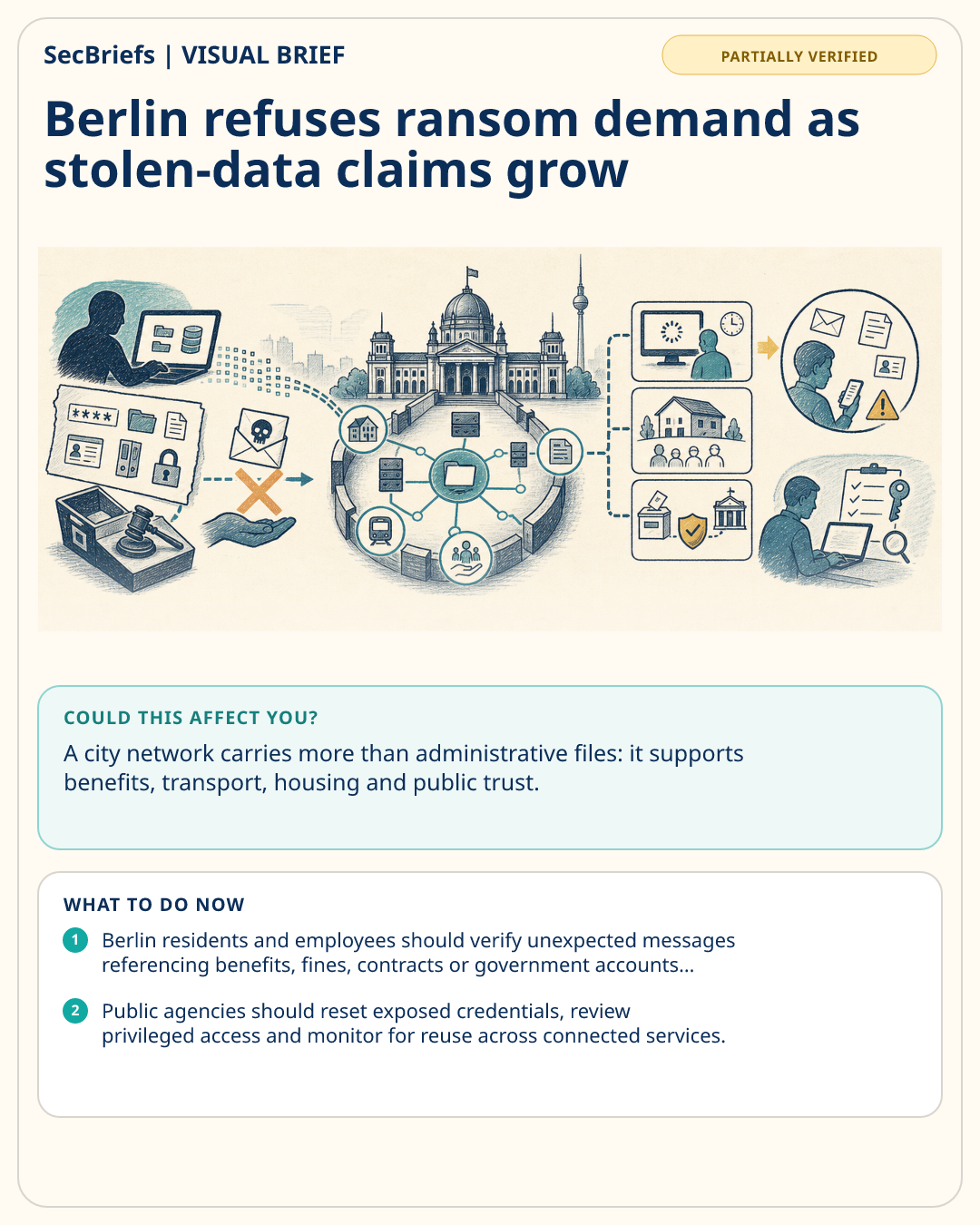
Berlin officials say the city-state will not pay an extortion demand following the August compromise of its administrative network. Reuters reported that the Rhysida ransomware group claimed to have stolen 5.79 terabytes of data and offered the material for auction. The group’s detailed claims—including passwords, contracts, personnel files and classified information—have not been independently verified, and officials say the scope is still being examined. The attack temporarily disrupted services including housing-benefit processing while affected departments were isolated. Officials said election infrastructure was not affected ahead of Berlin’s September vote. Fresh German reporting on 30 August says the Senate continues to limit operational detail while investigations proceed. The important confirmed facts are the extortion attempt, the city’s refusal to pay and the continuing uncertainty over what information may have left the network. That distinction protects residents from panic while still recognising that credible uncertainty is itself an operational and privacy risk requiring precautionary action.
WHY IT MATTERS
A city network carries more than administrative files: it supports benefits, transport, housing and public trust. Even when election systems are separated, stolen government records can enable identity fraud, targeted phishing or pressure against employees and residents. The gap between an attacker’s detailed leak claim and the government’s still-evolving assessment also shows why public statements must distinguish confirmed impact from criminal advertising. Public agencies also need a recovery measure beyond reconnecting systems: residents must know which services are safe, which records remain uncertain and where genuine notices will appear.
WHO SHOULD CARE
Berlin residents, public-sector employees, municipal IT leaders, election officials, benefit recipients, privacy teams and operators of interconnected government services. Banks and identity providers should watch for scams exploiting apparently official Berlin data.
WHAT TO DO NOW
- Berlin residents and employees should verify unexpected messages referencing benefits, fines, contracts or government accounts through official channels.
- Public agencies should reset exposed credentials, review privileged access and monitor for reuse across connected services.
- Incident teams should maintain separate confirmed, suspected and attacker-claimed impact registers for public communication.
- Continuity plans should cover benefit and citizen-service processing when departments must be isolated from the network.
- Organizations receiving leaked-data claims should validate samples safely without paying, downloading uncontrolled archives or repeating unverified totals.
VERIFICATION NOTE
Reuters independently confirmed the extortion attempt, Berlin’s refusal to pay and the attacker’s 5.79 TB claim. Berlin officials say scope remains under examination and election systems were unaffected. Detailed Rhysida claims are treated as unverified; 30 August German reporting confirms the investigation remains active.