Scammers exploit trusted enterprise chat to steer victims into payments
THE BRIEF
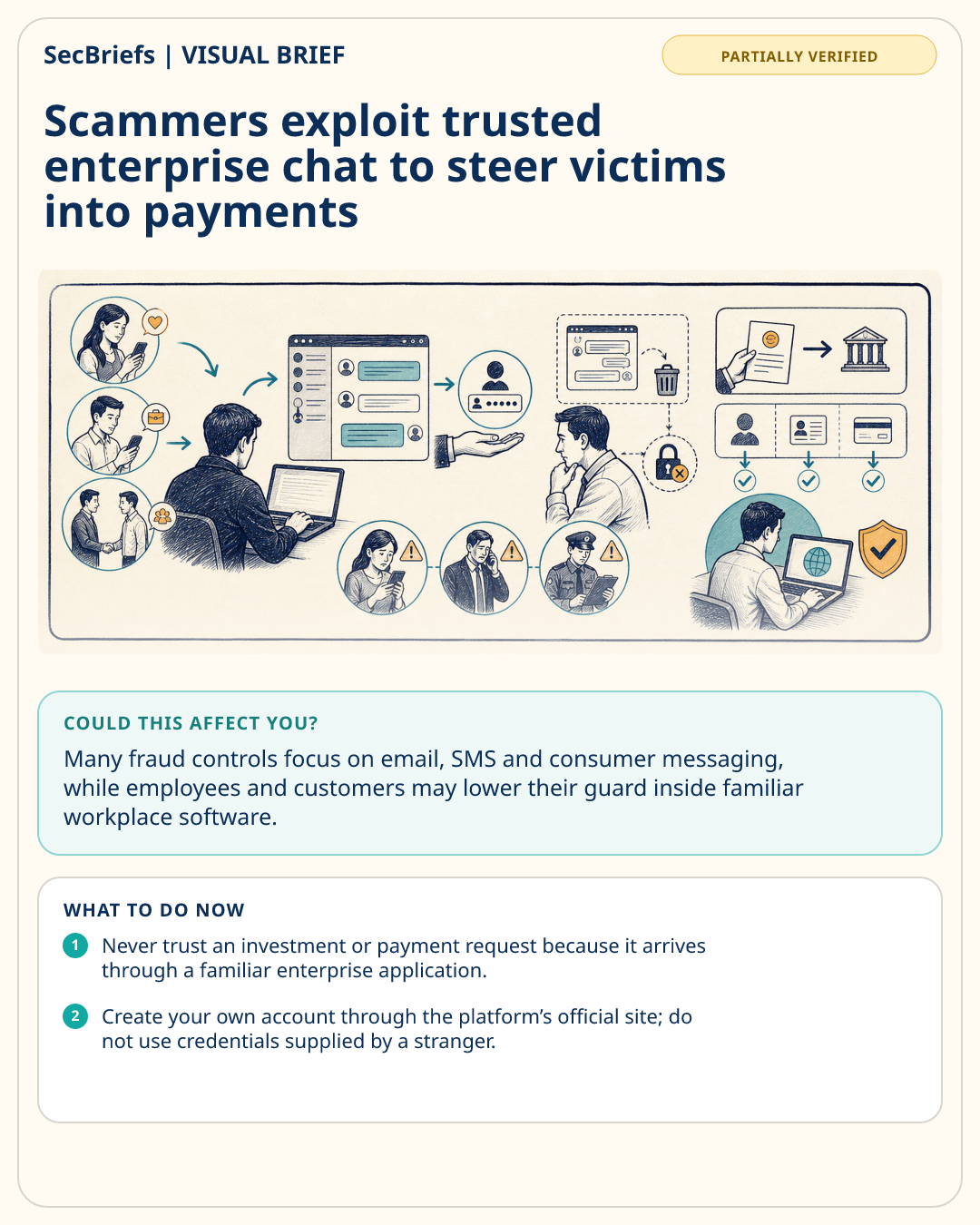
WIRED reports that scammers in China are moving prospective victims from social media and dating, recruitment or business conversations into legitimate enterprise chat tools such as Microsoft Teams and Webex. The platforms’ workplace reputation can make the interaction appear safer, while scammers may create the account and hand the victim login credentials—leaving the criminal able to disable access and erase the victim’s route back to chat evidence. WIRED interviewed victims, reviewed hundreds of Chinese App Store comments, cited local police warnings and obtained responses from Microsoft and Zoho. Microsoft said it investigates abuse and has added a scam-warning banner for Teams users in China; Zoho said it suspended suspected accounts and plans to discontinue a free offering there. Reported individual losses range widely, but those amounts and the total scale are not independently established. The broader pattern is well supported: a trusted corporate interface does not authenticate the person controlling the conversation, validate an investment or make a payment request safe.
WHY IT MATTERS
Many fraud controls focus on email, SMS and consumer messaging, while employees and customers may lower their guard inside familiar workplace software. Scammers can exploit that trust without breaching Microsoft, Cisco or Zoho: the deception occurs through accounts and organizations they control. The case also shows an evidence problem—when criminals provide the credentials, they may later revoke access to the conversation. Banks and businesses should treat the payment instruction, counterparty and account ownership as separate facts that require independent verification, regardless of the channel’s brand.
WHO SHOULD CARE
Consumers, bank fraud teams, payment operations, corporate security and identity administrators, customer-protection teams, investigators and employees who receive investment, recruitment or transfer requests through collaboration platforms.
WHAT TO DO NOW
- Never trust an investment or payment request because it arrives through a familiar enterprise application.
- Create your own account through the platform’s official site; do not use credentials supplied by a stranger.
- Verify the person and payment destination through an independent channel before transferring money or taking a loan.
- Capture evidence and report suspicious accounts early, before the account owner can revoke access to the conversation.
- Banks and employers should add Teams, Webex and similar services to fraud awareness, reporting and monitoring scenarios.
VERIFICATION NOTE
WIRED interviewed victims, analyzed Chinese App Store reviews, cited local police warnings and obtained responses from Microsoft and Zoho. The abuse pattern is strongly reported, but individual loss amounts and total scale are not independently established.