Unit 42 reports agentic AI compressing enterprise attacks
THE BRIEF
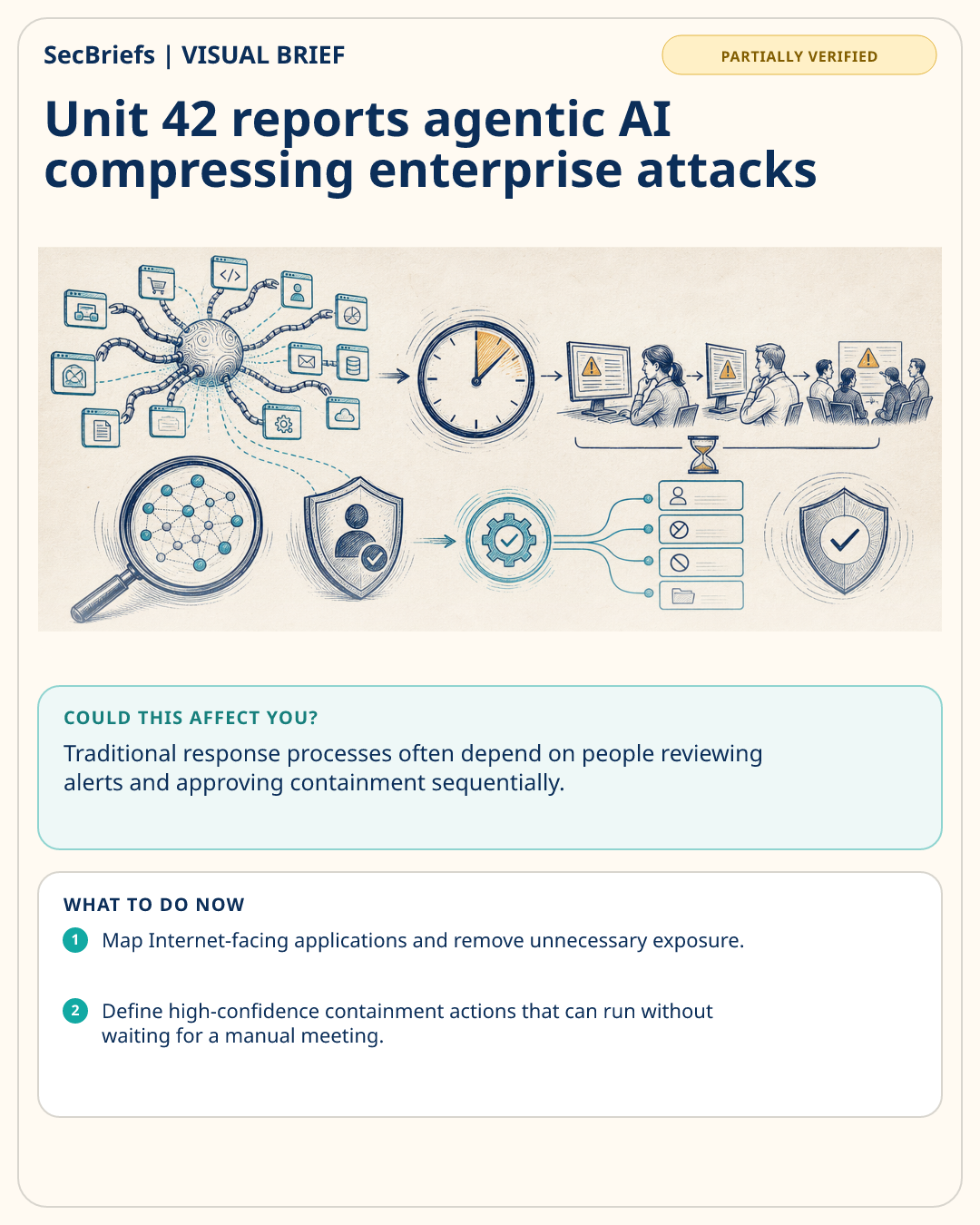
Palo Alto Networks’ Unit 42 says it is investigating a customer intrusion in which an attacker used an agentic framework to exploit 50 applications and other weaknesses across an enterprise in less than 10 hours. Unit 42 estimated that comparable work would previously have taken at least 10 days. In a media briefing reported by CyberScoop, researchers said attackers are already applying AI to malware development, social engineering, delegation and ransomware negotiations, although fully autonomous end-to-end attacks are not yet the norm. The report does not identify the victim, applications, vulnerabilities, attacker or business impact, so those details cannot be independently assessed. It also does not establish that every AI-assisted attack will move at the same speed. The credible signal is narrower but important: automation can compress discovery and exploitation timelines across a large attack surface, leaving defenders less time to triage, contain and recover. Response design must increasingly assume machine-speed activity.
WHY IT MATTERS
Traditional response processes often depend on people reviewing alerts and approving containment sequentially. If one actor can probe dozens of applications in hours, that model may be too slow even when individual controls work. Organizations need stronger attack-surface visibility, identity controls and pre-authorized containment for high-confidence events. The case also shows why claims about AI attacks should be tied to observed behavior rather than broad assumptions about autonomy. Speed itself becomes a control requirement: detection that arrives after automated exploitation is operationally equivalent to no detection at all.
WHO SHOULD CARE
CISOs, security operations leaders, incident responders, identity teams, application owners, cyber insurers and executives deploying autonomous agents should reassess whether detection and containment can operate at the speed described.
WHAT TO DO NOW
- Map Internet-facing applications and remove unnecessary exposure.
- Define high-confidence containment actions that can run without waiting for a manual meeting.
- Use short-lived credentials and least privilege for agents, applications and automation.
- Exercise an incident in which dozens of applications are probed within hours.
- Measure detection-to-containment time across identity, cloud and application controls.