Researchers find destructive Lotus Wiper campaign targeting Venezuela’s energy sector
THE BRIEF
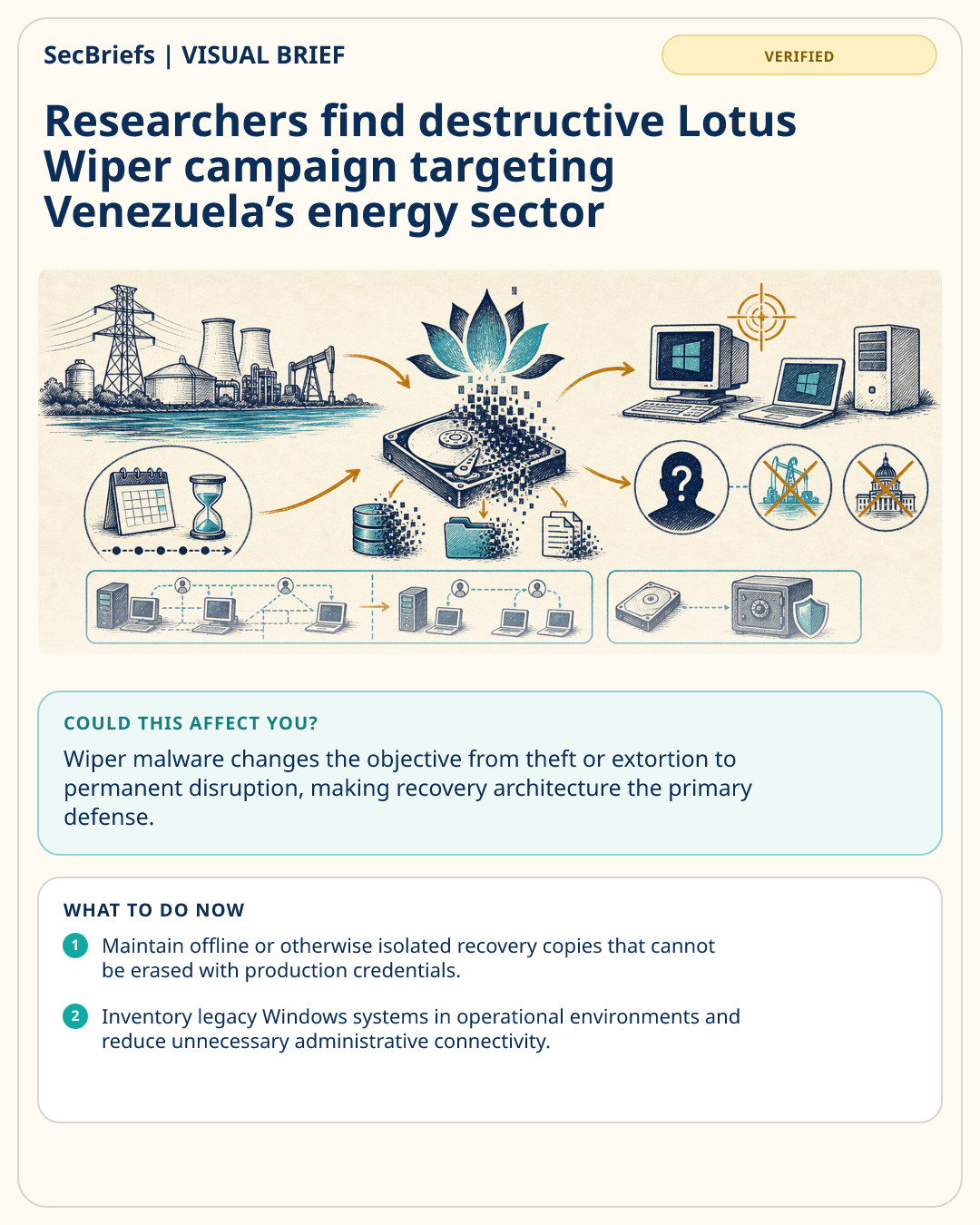
Kaspersky researchers reported a targeted destructive-malware campaign against Venezuela’s energy and utilities sector using a previously undocumented tool they named Lotus Wiper. The malware is designed to erase data from physical drives and delete files across storage, leaving affected systems difficult or impossible to restore. Researchers said the operation appeared highly targeted and financially unmotivated, and noted that attackers focused on machines running older Windows versions, suggesting prior knowledge of the environment. Technical evidence indicated preparation months before the destructive activity. The identity of the threat actor was not established. The reporting also stressed an important attribution boundary: Venezuela’s state oil company had previously reported a separate cyberattack, but there was no proof that Lotus Wiper was used in that incident, and no evidence connected the wiper campaign to the U.S. government. The security lesson is therefore operational rather than geopolitical: destructive malware can turn a cyber intrusion into a recovery and continuity crisis very quickly.
WHY IT MATTERS
Wiper malware changes the objective from theft or extortion to permanent disruption, making recovery architecture the primary defense. Energy and utility operators must assume that attackers who reach administrative systems may attempt to destroy both production data and the systems used to restore it. The absence of confirmed attribution should not delay defensive action or be replaced by political speculation. Organizations should therefore test whether recovery remains possible when production credentials and systems are assumed lost.
WHO SHOULD CARE
Energy operators, critical-infrastructure teams, incident responders and organizations with legacy Windows systems should care because destructive malware can convert an intrusion into prolonged operational outage without a ransom or recovery key.
WHAT TO DO NOW
- Maintain offline or otherwise isolated recovery copies that cannot be erased with production credentials.
- Inventory legacy Windows systems in operational environments and reduce unnecessary administrative connectivity.
- Detect destructive file and disk operations, especially when they follow earlier lateral movement or privilege escalation.
- Separate technical evidence from geopolitical attribution when communicating destructive incidents.